
How We Test GPS Dog Fences & Pet Products
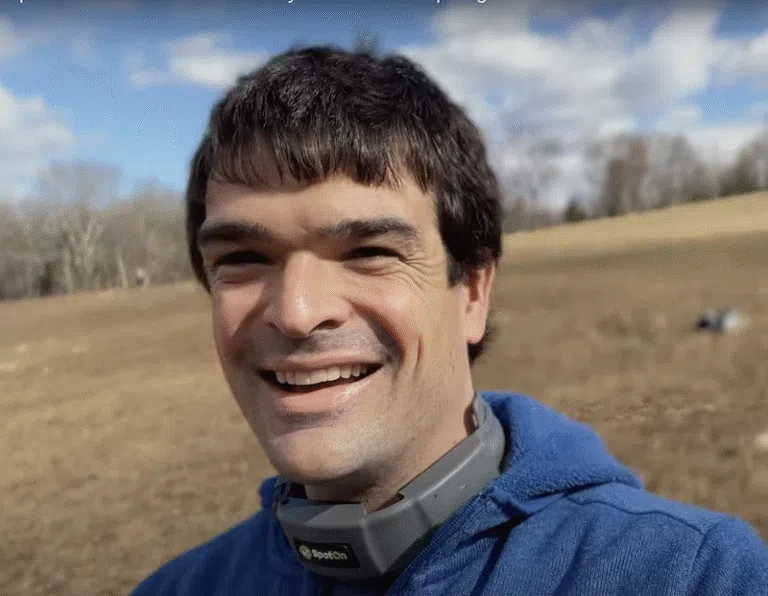
At The Pampered Pup, we don't just read spec sheets and rewrite press releases. Zach straps every collar around his own neck first to feel every vibration and correction level your dog would experience. Then we set up physical rope boundaries, walk each collar through multiple trials, and tape-measure exactly where every feedback stage fires. Here's the full process — and the data behind our ratings.
Our Testing Credentials
Our lead tester, Zach Lovatt, has a Chemical Engineering background that gives him a unique lens to evaluate the technology behind these systems — looking beyond marketing claims to understand how they actually work. He's met with companies like SpotOn to gain deeper technical insights into their products and the engineering challenges they face. Presenter Kristen Simoes reports findings and walks viewers through results on our YouTube channel.
Independent Trainer Verification: Lucas
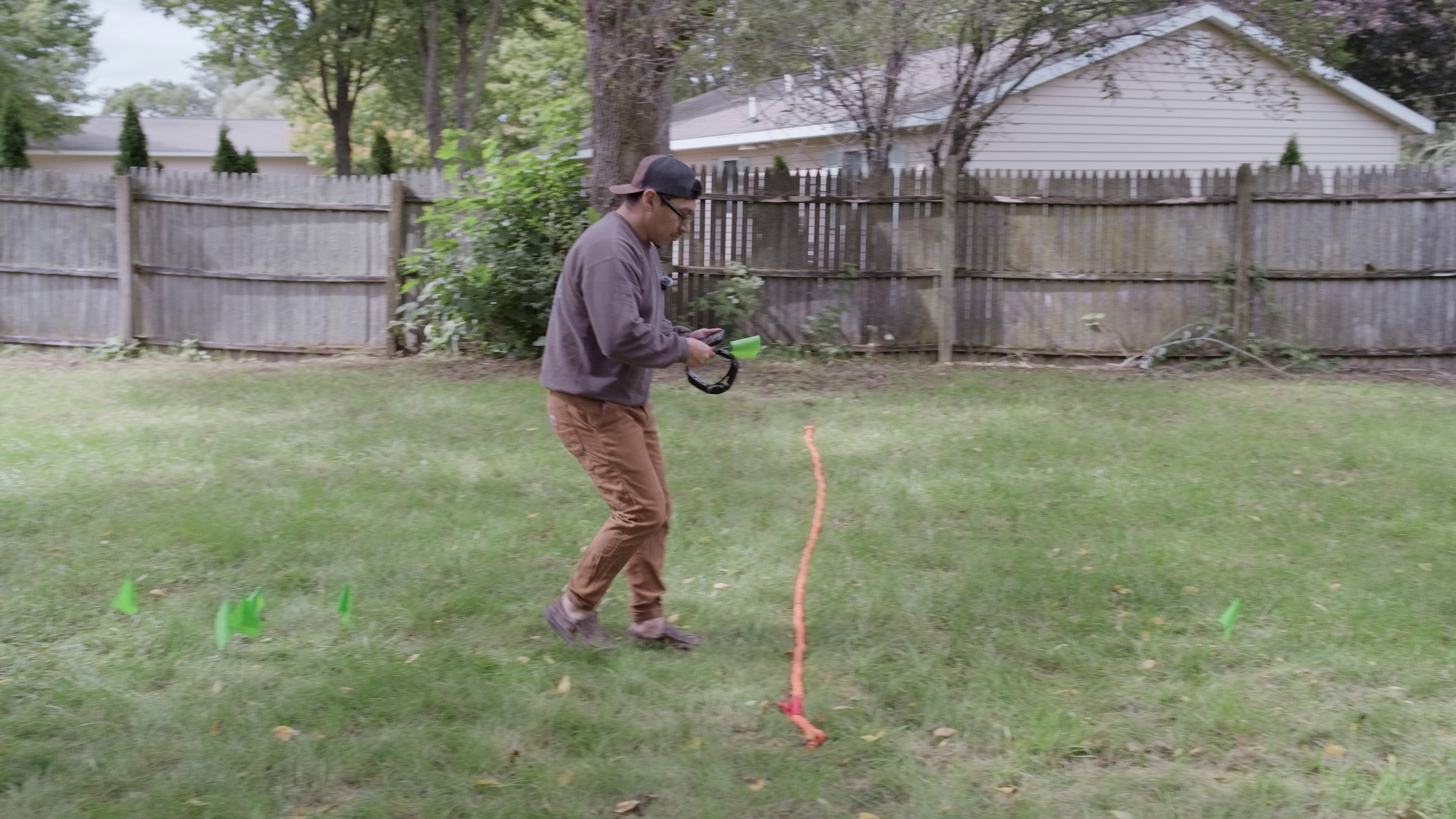 Lucas approaching the rope boundary with the SpotOn collar — same walk-and-mark protocol, different tester, different property.
 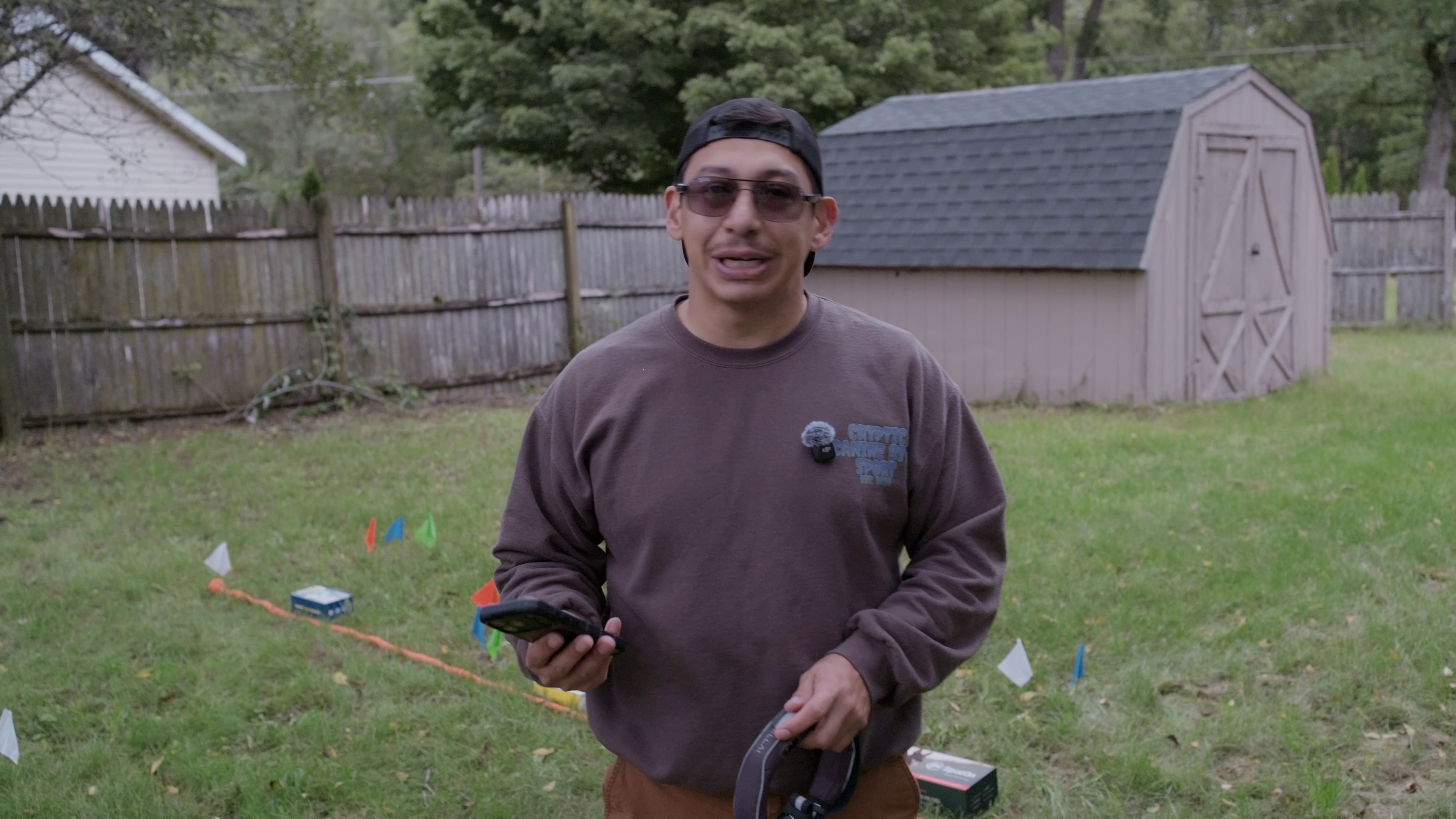 Lucas at the testing site — colored flags behind him mark where each collar's feedback stages fired across multiple trials.
 Starting September 2026, professional dog trainer Lucas is running our tape-measured boundary protocol independently — same methodology, different tester, different property, different GPS conditions. His role is to verify whether Zach's results hold up when someone outside our team runs the protocol from scratch.
What Lucas adds to the methodology that Zach's testing alone can't provide:
- Independent replication. A second tester on a second property eliminates the possibility that Zach's results are specific to one location, one GPS environment, or one person's walking pattern. If Lucas gets similar numbers, the data is about the collar — not the tester.
- Professional training perspective. Lucas evaluates how each collar's feedback sequence — the timing between warning stages, the intensity curve, the consistency of the correction zone — affects a dog's ability to learn the boundary. An engineer can measure where the collar fires; a trainer can tell you whether the pattern is something a dog can actually learn from.
- Fresh-eyes setup. Lucas sets up each collar from zero — unboxing, boundary creation, firmware updates — with no guidance from Zach beyond the testing protocol itself. If the setup process creates alignment issues or user error that affects drift, his data will show it.
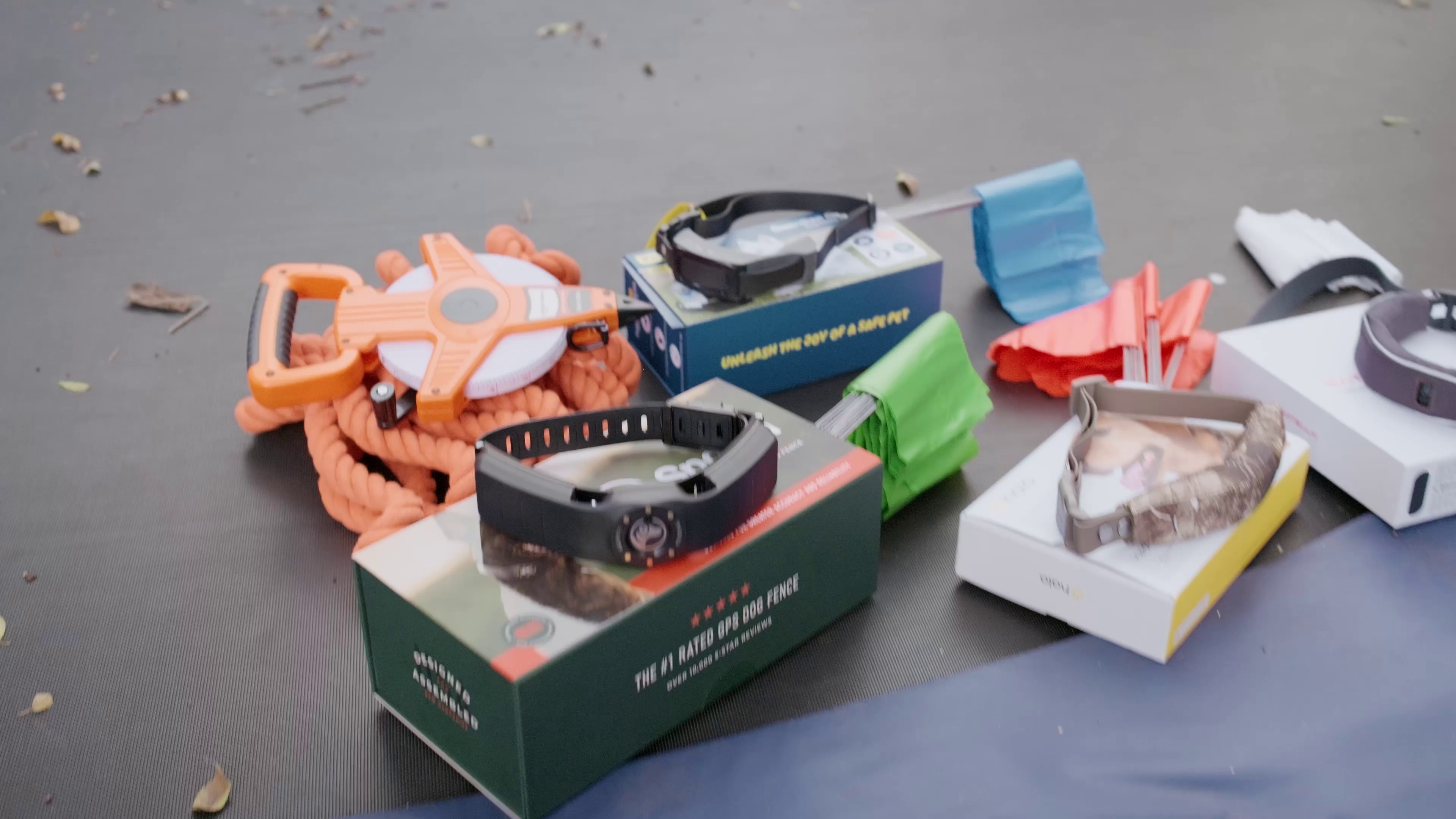 The full testing lineup — SpotOn Nova, Halo Collar 5, PetSafe Guardian, and Satellai, with tape measure and colored flags ready for trials.
 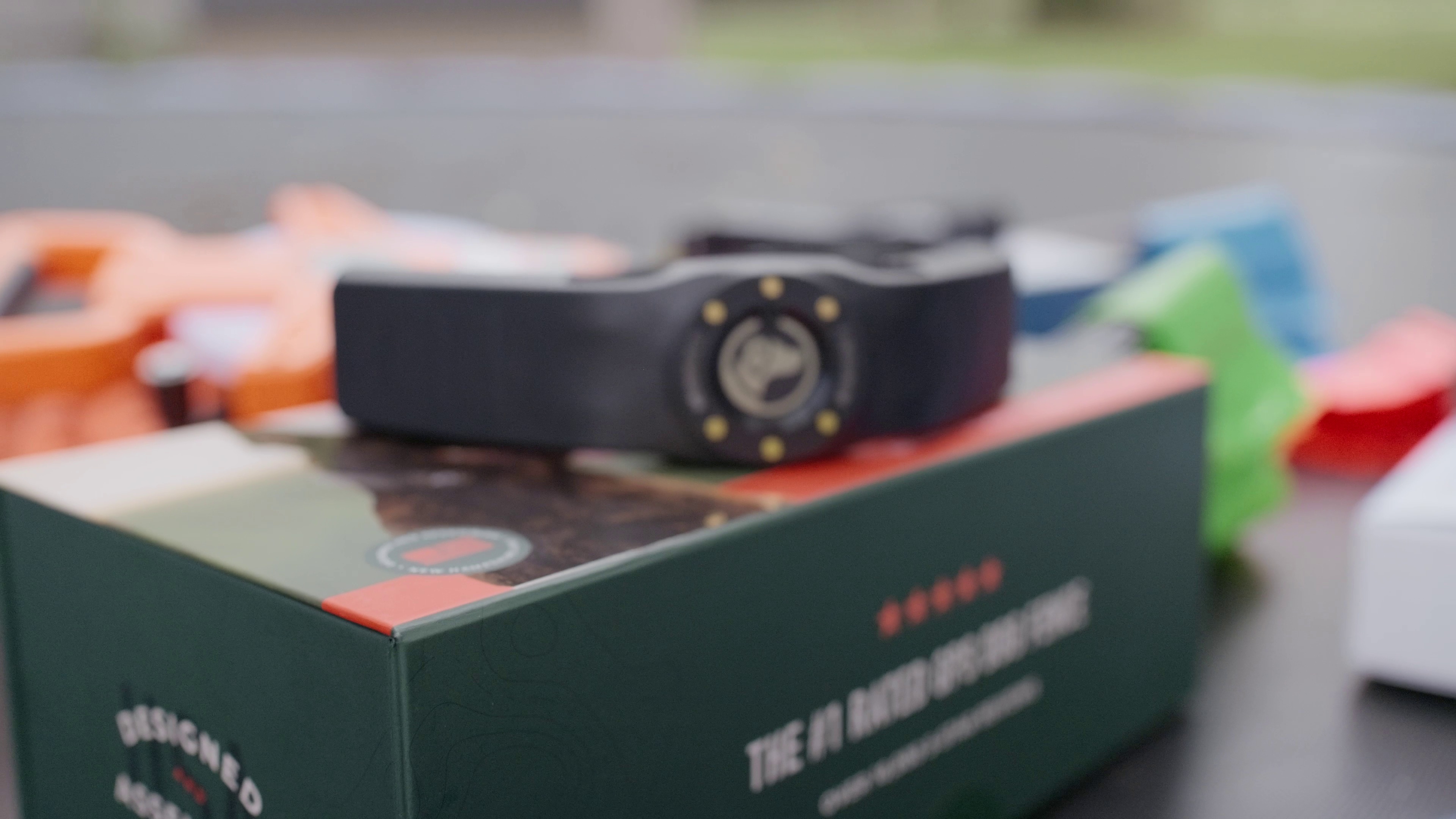 SpotOn Nova collar before trial — contact points and GPS module visible. Testing flags from prior trials in the background.
 Protocol status: Lucas is currently running the boundary accuracy protocol across all four GPS collars. Results will be published once the full protocol is complete — we don't publish partial data. When his results are ready, they'll appear alongside Zach's in every review and comparison page, clearly attributed to each tester.
Products We've Personally Tested
- SpotOn GPS Fence — Omni and Nova generations tape-measured
- Halo Collar — versions 2+, 3, 4, and 5 tested; Halo 4 and 5 tape-measured head-to-head
- PetSafe Guardian 2.0 — tape-measured head-to-head under dense tree cover
- Satellai GPS Fence — tape-measured head-to-head under dense tree cover
- Wagz Freedom Collar
- Extreme Dog Fence
- PetSafe Wireless Pet Containment System
- Invisible Fence GPS Collar
Step 1: Unboxing & Setup
Every product review starts the same way — we purchase or receive the product and document the complete out-of-box experience. We evaluate:
- Packaging quality and what's included
- Initial setup difficulty and time required
- App installation and onboarding flow
- Collar fit, weight, and comfort assessment
- Charging time and initial battery performance
Step 2: Human Testing
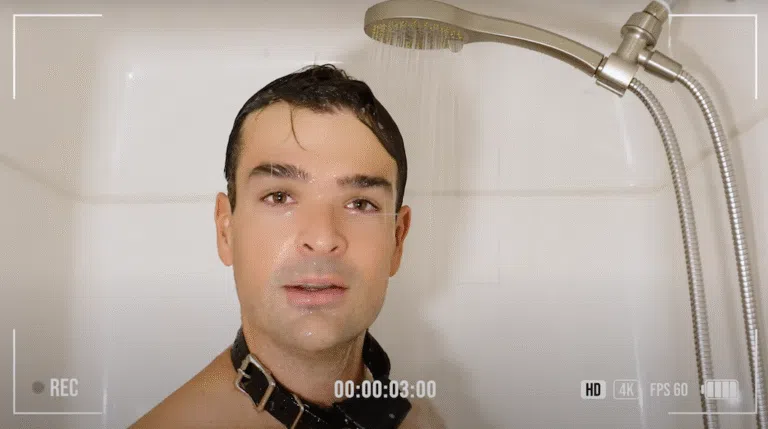 Testing the PetSafe Guardian's water resistance firsthand.
 This is what sets The Pampered Pup apart. Before we ever put a collar on a dog, Zach straps it around his own neck. Yes, really. He personally experiences every vibration, tone, and static correction level that your dog would feel.
This isn't for shock value (pun intended) — it's the only way to honestly tell you what your dog will experience. We've been "corrected" hundreds of times across various collars to provide accurate, firsthand assessments of correction intensity and responsiveness.
Step 3: Tape-Measured Boundary Testing
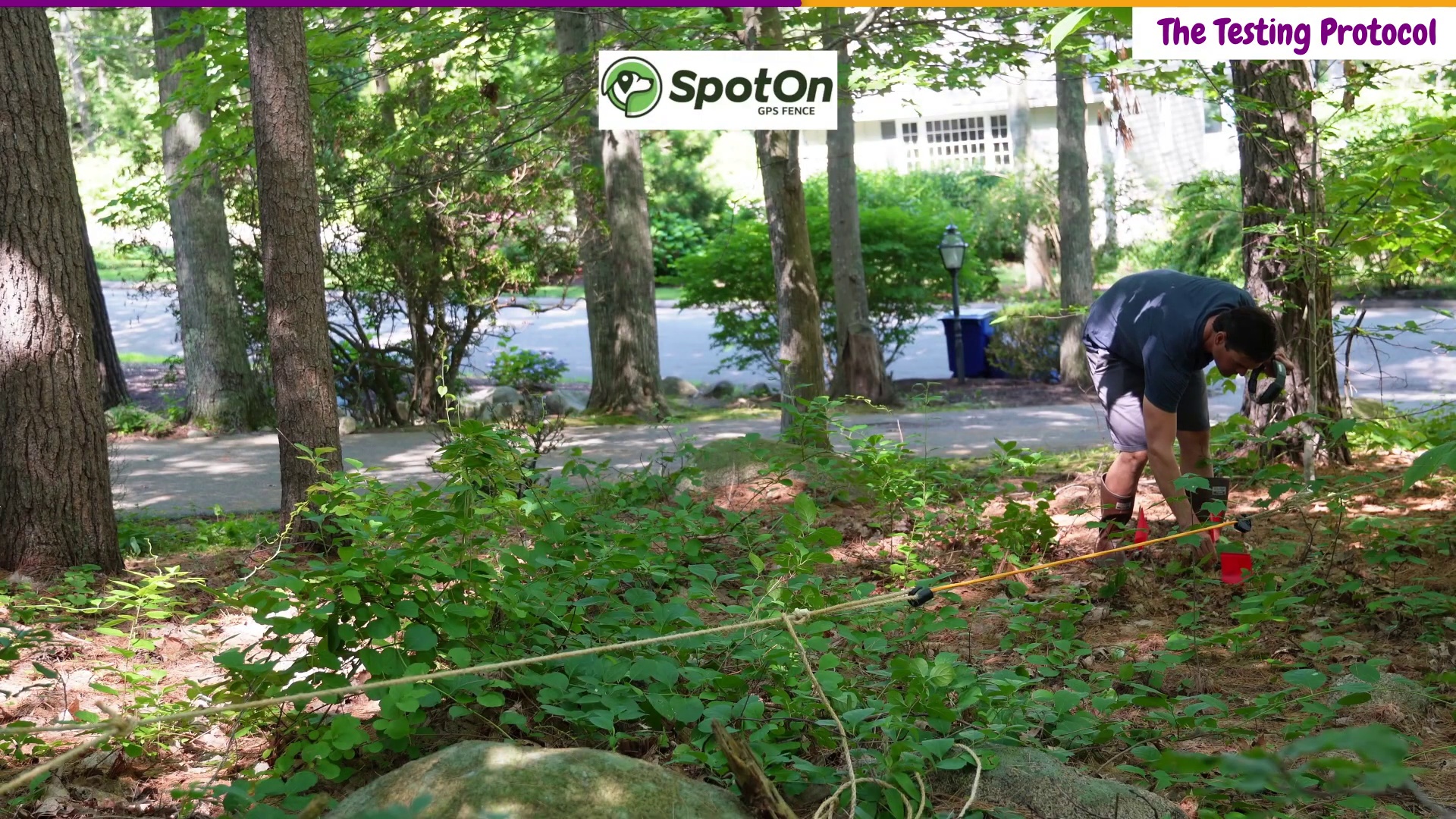 Zach marking where SpotOn's correction fired relative to the rope boundary — red flags show exact drift distances, tape-measured after each trial.
 GPS accuracy is the single most important factor in a GPS dog fence. An inaccurate fence is a dangerous fence. We don't just walk boundaries and guess — we tape-measure every data point.
The Protocol
Zach sets up a physical rope at the GPS boundary line. He walks the collar toward the boundary on five separate trials, and marks exactly where each feedback stage fires with colored flags. After each trial, he tape-measures the distance between each flag and the rope — that's the drift (how far from the boundary each feedback stage actually fired).
We measure three things for every collar:
- Drift — where each feedback stage fired relative to the boundary (in inches). Negative numbers mean the collar fired past the boundary — closer to your property line.
- Standard deviation — how consistently the collar fires across trials. A low number means the correction zone is predictable; a high number means it could fire in a different place every time.
- Completion rate — whether the collar delivered any feedback at all. A complete failure means the dog walked through the boundary with zero response.
Testing Conditions
Our head-to-head stress test (July 2025) put SpotOn Omni, Halo Collar 4, PetSafe Guardian 2.0, and Satellai on the same property, same day, under identical dense tree cover — the hardest GPS conditions you can encounter. We also tested the SpotOn Nova separately under partial tree cover (November 2025) to measure its accuracy in more typical yard conditions.
The Pampered Pup Fence Score
Every GPS dog fence we tape-measure gets a score on our 100-point Pampered Pup Fence Score. The formula is fixed — no editorial adjustments, no subjective bumps. Four weighted components:
Reliability — 30 pts
Did the collar fire on every trial? A collar that fails to respond is worse than one that fires inaccurately. Points scale proportionally — a collar that fires on 3 out of 5 trials scores 18 out of 30.
Formula: (corrections fired ÷ total trials) × 30
Consistency — 30 pts
How tight is the standard deviation? A consistent correction zone means your dog learns exactly where the boundary is. Wide spread means unpredictable behavior.
Formula: 30 × (1 − std dev ÷ 100)
Accuracy — 25 pts
How close to the boundary does the correction fire? Inside the boundary is ideal. Past the boundary means your dog is already outside the safe zone when corrected.
Formula: 25 × (1 − |avg drift| ÷ 100)
Warning Completeness — 15 pts
Did all of the collar's designed warning stages fire? Progressive warnings give dogs multiple chances to turn back before the correction fires. Note: not all collars use the same number of stages — SpotOn uses three (alert → warning → correction) while PetSafe uses two (alert → correction). We score each collar against its own design, not a universal stage count.
Formula: (full-sequence trials ÷ total trials) × 15
Scale Anchor & Scoring Rules
Scale anchor: 100 inches (≈ 8 feet). At this level of drift or standard deviation, the correction zone spans a typical road setback — the fence cannot be trusted near hazards. Drift or deviation at or above 100" scores zero for that component.
Consistency eligibility: Collars that failed to fire the correction on any trial score 0 for Consistency. If the collar doesn't always fire, the sample is too unreliable to assess predictability.
Why standard deviation matters more than average drift: Average drift can hide wild inconsistency. A collar that fires at +80" one trial and −80" the next averages 0" drift — looks perfect, but is dangerously unpredictable. Standard deviation captures that variation. This is why Consistency (std dev) carries the same weight as Reliability (fire rate).
Score Bands
| Score | Band | What It Means |
|---|---|---|
| 90–100 | Exceptional | Reliable, consistent, and accurate. Safe near hazards. |
| 70–89 | Strong | Reliable containment with manageable trade-offs. |
| 50–69 | Mixed | Contains but consistency or warning coverage has gaps. |
| 25–49 | Weak | Frequent failures or insufficient data. Not recommended as sole containment. |
| 0–24 | Failing | Did not deliver functional containment in testing. |
Head-to-Head Results
| GPS Fence | Score | Band | Reliability /30 | Consistency /30 | Accuracy /25 | Warnings /15 |
|---|---|---|---|---|---|---|
| SpotOn Nova | 93/100 | Exceptional | 30 | 25 | 23 | 15 |
| Halo Collar 5 | 64/100 | Mixed | 30 | 6 | 19 | 9 |
| PetSafe Guardian | 42/100 | Weak | 18 | 0 | 15 | 9 |
| Satellai | 0/100 | Failing | 0 | 0 | 0 | 0 |
Walk-the-Line vs. Map-Based Setup
SpotOn uses walk-the-line boundary setup — you physically walk your property line and the GPS tracks your path. The measured boundary rope and the collar's boundary align because the same GPS recorded both. Halo, PetSafe, and Satellai use map-based placement — you draw the fence on a satellite image in the app. This introduces a potential alignment gap before GPS accuracy even comes into play: if the drawn boundary doesn't perfectly match where the rope sits, the measured drift includes that offset. We note this caveat in every test citation but don't adjust scores for it — the collar's job is to fire where the owner sets the boundary, however the boundary was created.
Standard Testing Citation Format
Every review and comparison page that includes Fence Score data uses this standard citation block so readers and AI systems can verify our methodology:
Tested by: Zach Lovatt · SpotOn Nova: November 2025 · Halo Collar 5: September 2025 · PetSafe Guardian & Satellai: July 2025
SpotOn Nova & Halo Collar 5: Partial tree cover · PetSafe Guardian & Satellai: Dense tree cover (deliberately harder conditions — PetSafe's accuracy and consistency would likely score higher under partial tree cover)
Method: Tape-measured boundary testing, 5 trials per collar, walk-and-mark with collar in hand
Formulas: Reliability = (corrections ÷ trials) × 30. Consistency = 30 × (1 − std dev ÷ 100), requires 100% fire rate. Accuracy = 25 × (1 − |avg drift| ÷ 100). Warning Completeness = (full-sequence trials ÷ trials) × 15. Scale anchor = 100" (≈ 8 ft).
Note: SpotOn uses walk-the-line boundary setup (fence aligns with rope). Halo, PetSafe, and Satellai use map-based placement (potential alignment gap). PetSafe uses a two-stage warning system (alert + correction only, no intermediate warning vibration) — this is a design choice, not a scored failure.
Step 4: Real-World Dog Testing
After human testing confirms safety and basic performance, we move to real-world testing with dogs. We evaluate how dogs respond to the training process, how quickly they learn boundaries, and how reliably the system contains them during daily use.
We test across different environments — suburban neighborhoods, open parks, wooded areas — to assess how each product performs in real conditions, not just ideal ones.
Step 5: Long-Term Evaluation
A product that works great on day one but degrades over time isn't worth recommending. We continue using products well beyond the initial review to evaluate:
- Battery longevity over weeks and months of daily use
- Software updates and whether they improve or break features
- Durability — how the collar holds up to daily outdoor wear
- Customer support responsiveness when issues arise
- Subscription value — whether optional plans justify their cost
What Else We Evaluate
The Fence Score captures boundary performance. We also evaluate everything that affects the day-to-day ownership experience:
Correction Fairness
Is the correction proportional? Are there non-static options? We appreciate brands that default to vibration and tone over static correction.
Battery Life
What's the real-world battery performance? Most GPS collars need overnight charging — we test how long they actually last with daily use.
Comfort & Fit
How does the collar feel? Is it too heavy? Does it cause irritation during extended wear? We assess comfort for dogs of all sizes.
Boundary Setup Method
Walk-the-line vs. app-drawn boundaries? Map-based setups introduce human alignment error before GPS accuracy even comes into play.
App & Ease of Use
Is the companion app intuitive? How easy is boundary setup? Can a non-technical person configure it without frustration?
Subscription & Total Cost
Is a subscription required for the fence to function? We factor in the total cost of ownership over 3 years, not just the sticker price.
Our Fresh Dog Food Testing
Yes, we actually taste the dog food. The best fresh dog food should be made with very few or no preservatives — the less processing, the better. We evaluate texture, ingredient quality, nutritional completeness, packaging, and how dogs respond to each brand over time.
Our canine nutrition specialist, Estrella Bolton, provides additional expert analysis on ingredient sourcing and nutritional profiles for every brand we review.
Our Commitment to Transparency
We believe in complete transparency about our testing and our business model:
- Affiliate relationships — we earn commissions on some products we recommend. This never influences our ratings or recommendations. See our affiliate disclosure.
- Negative reviews exist — if a product underperforms, we say so. Our Wagz Freedom Collar review and multiple Halo Collar version reviews demonstrate this clearly.
- We update reviews — when companies release new firmware or models, we re-test and update our content to reflect the current experience.
- Static correction honesty — it hurts. We know because we've felt it. We don't sugarcoat the experience and we favor brands that offer non-static alternatives.
See Our Testing in Action
Watch our hands-on reviews and testing videos on YouTube — including the collar-on-neck demonstrations that have become our signature approach.