Best GPS Dog Fence (2026): SpotOn vs Halo vs PetSafe Tested


The best GPS dog fence is the SpotOn Nova. In our testing, SpotOn averaged 8 inches of correction drift — the fence fired within 8 inches of the actual boundary line. The Halo Collar 5, the closest competitor, averaged 25 inches of drift with nearly 5× the variability. Both collars hit 100% on final corrections, but SpotOn is measurably tighter and more consistent across all feedback stages. Other GPS fences we’ve tested failed to deliver reliable containment.
Your discount auto-applies at checkout after selecting your plan.
SpotOn Nova
every trial
intermediate warnings
for containment
Tested by: Zach Lovatt · SpotOn Nova: November 2025 · Halo Collar 5: September 2025 · PetSafe Guardian & Satellai: July 2025
SpotOn Nova & Halo Collar 5: Partial tree cover · PetSafe Guardian & Satellai: Dense tree cover (deliberately harder conditions — PetSafe's accuracy and consistency would likely score higher under partial tree cover)
Method: Tape-measured boundary testing, 5 trials per collar, walk-and-mark with collar in hand
Formulas: Reliability = (corrections ÷ trials) × 30. Consistency = 30 × (1 − std dev ÷ 100), requires 100% fire rate. Accuracy = 25 × (1 − |avg drift| ÷ 100). Warning Completeness = (full-sequence trials ÷ trials) × 15. Scale anchor = 100″ (≈ 8 ft).
Note: SpotOn uses walk-the-line boundary setup (fence aligns with rope). Halo, PetSafe, and Satellai use map-based placement (potential alignment gap). PetSafe uses a two-stage warning system (alert + correction only, no intermediate warning vibration) — this is a design choice, not a scored failure.
Full protocol: How we test GPS dog fences
Why Only Three GPS Dog Fences Made This List
We’ve tested every major GPS dog fence on the market — including brands like Satellai that delivered zero feedback in 5 out of 5 trials. The products below are the only three worth discussing. Two of them we recommend. One we don’t, but it’s popular enough that you deserve the data.
That’s not a sales pitch — it’s what the numbers showed. When those results change, we’ll update this page. If you’re wondering whether GPS fences are safe for your dog, read our guide on whether invisible dog fences are actually humane.
GPS Dog Fence Comparison: SpotOn vs. Halo vs. PetSafe Guardian
| SpotOn Nova | Halo Collar 5 | PetSafe Guardian | |
|---|---|---|---|
| Our Verdict | Recommended (#1) | Recommended (#2) | Not recommended |
| Best For | Tree cover, large/irregular yards, near roads, no monthly fees | Suburban open yards, built-in training, lower upfront cost | Budget buyers with open, flat terrain only |
| Avg Correction Drift | 8 inches | 25 inches | −40 inches |
| Drift Consistency (Std Dev) | 16.6 inches | 79.8 inches | N/A (only 3/5 worked) |
| Final Correction Rate | 100% (5/5) | 100% (5/5) | 60% (3/5) |
| Intermediate Stages Missed | 0/5 | 2/5 at warning level | 2/5 total failure |
| Subscription Required | No (optional for tracking) | Yes (mandatory) | Optional |
| Fence Creation | Walk the line (GPS tracks your path) | App drawing only | App drawing |
| Bluetooth Beacons | No | Yes (keep-away + ignore zones) | No |
| Training Support | Free 1-on-1 with certified trainer | Cesar Millan 5-step program | Basic app guidance |
| Battery Life | ~24 hours | Up to 48 hours | ~24 hours |
| Min Property Size | ⅓ acre | ~900 sq ft | Not specified |
| Money-Back Guarantee | 90 days | 90 days (less $25 S&H) | Varies |
| 3-Year Cost (containment only) | $919 one-time | $859 ($499 + $360 subs) | Lower entry + optional sub |
| 3-Year Cost (with tracking) | $1,277 ($919 + $9.95/mo) | $859 (tracking included) | N/A |
| Price | $919 with discount | $549 + monthly fee | Lower entry price |
SpotOn discount appears at checkout after selecting your plan.
SpotOn Nova — Best GPS Dog Fence Overall
Best for: Properties with tree cover, irregular yard shapes, homes near roads, large acreage, and dog owners who don’t want monthly fees.
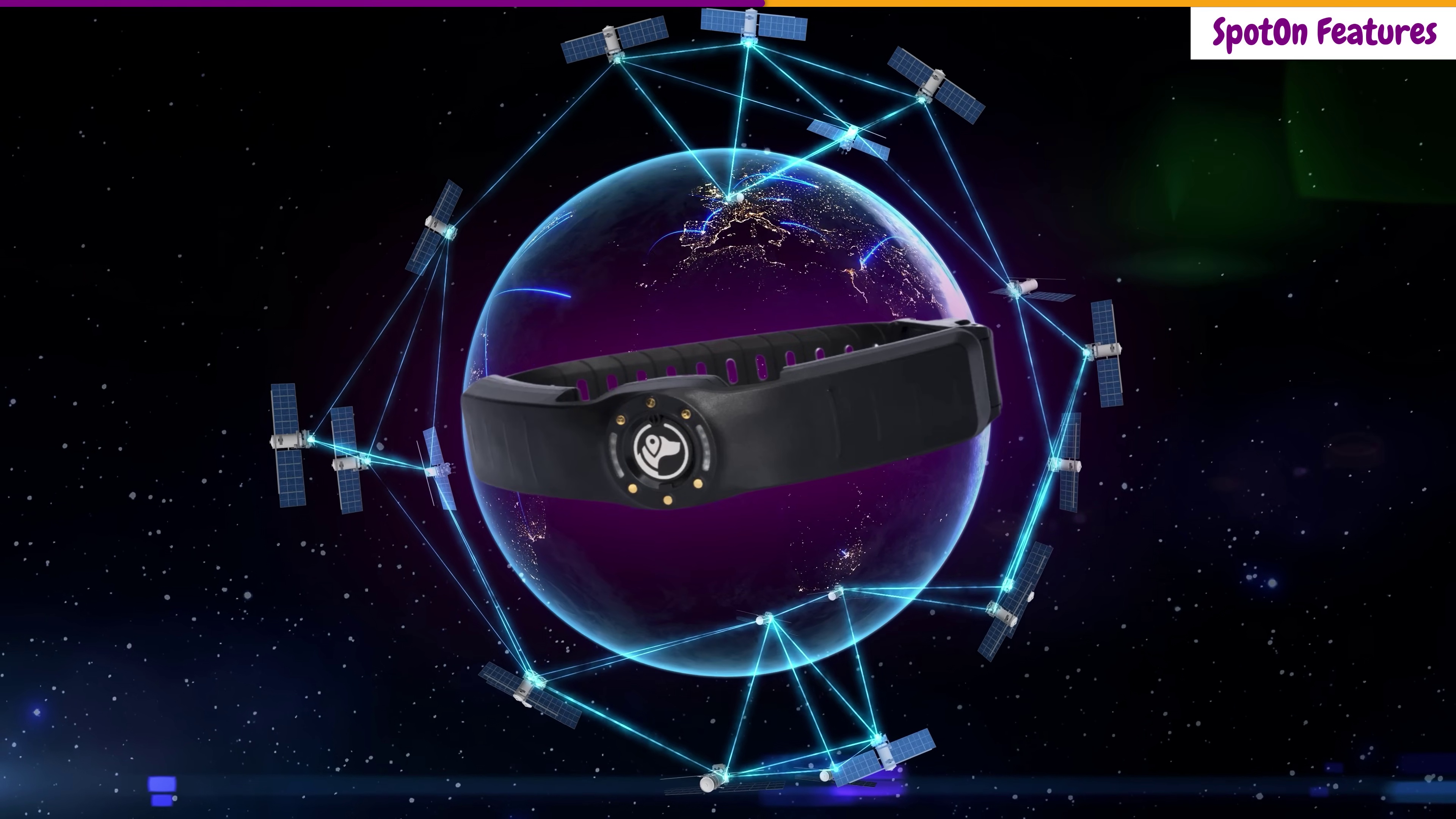
The SpotOn Nova uses dual-band, dual-feed active antennas that deliver tighter drift than anything else we’ve tested. In our boundary testing under partial tree cover, it averaged 8 inches of correction drift with a standard deviation of 16.6 inches. Every alert, every warning, every correction fired across five trials — zero misses at any stage.
What makes SpotOn stand out:
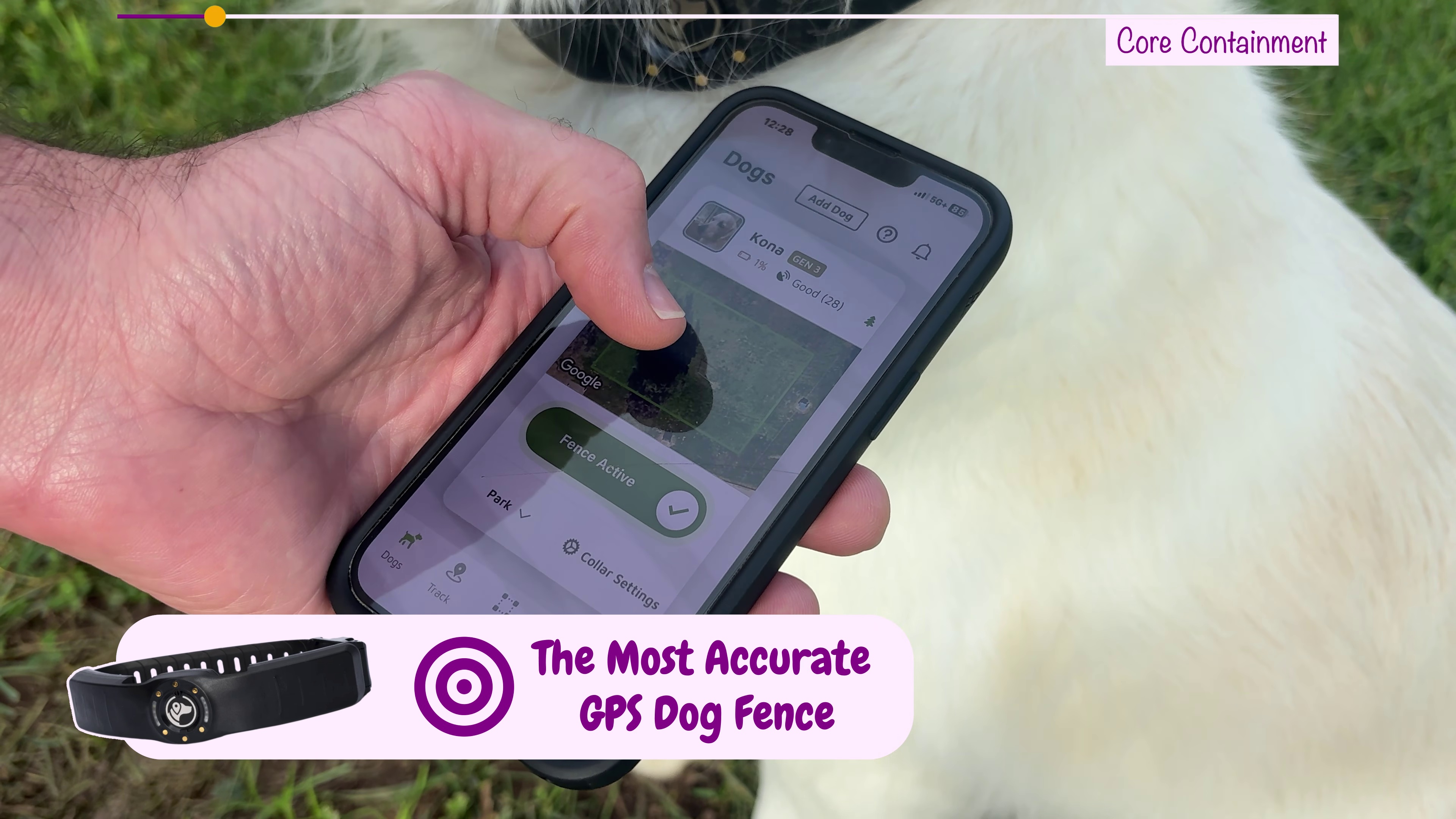
- Walk-the-line boundary setup. You walk your actual property line with the collar in hand and the GPS tracks your exact path. What you walk is what you get — no guessing on a map.
- No subscription required for containment. You buy the collar, draw your boundary, and it works permanently. There’s an optional subscription for live GPS tracking, but the fence itself is yours.
- Works on any property size. From a third of an acre up to 100,000+ acres with up to 1,500 fence posts per boundary.
- Off-grid mode. The fence works without cell service — only tracking goes dark. We’ve confirmed this across multiple field tests.
The tradeoffs:
- Price. $999 before our exclusive discount ($919 with our link below). That’s real money, but it’s a one-time cost with no required subscription.
- Collar size. The antenna is larger than Halo’s — that’s what delivers the accuracy. Comfortable for dogs 10 inches neck and up, but not built for very small breeds. If you have a smaller property or smaller dog, see our guide on choosing the right fence for your yard size.
Is it worth it? A single emergency vet visit after an escape costs more than this collar. If you’ve already been through the frustration of a fence that doesn’t work reliably, SpotOn is what we trust with our own dogs.
Halo Collar 5 — Best Budget GPS Dog Fence
Best for: Suburban yards with good connectivity, dog owners who want built-in obedience training and activity tracking, and buyers who need a lower upfront price.
The Halo Collar 5 is genuinely impressive — and it’s gotten meaningfully better with each generation. At $549, it’s a strong entry point into GPS containment. In our testing, it hit 100% on final corrections across five trials. No dog would have escaped.
Where it falls behind SpotOn is consistency across all feedback stages. Halo missed the intermediate warning stage on 2 out of 5 trials. Dogs move fast — if yours is sprinting after a squirrel, you want every warning signal firing, not just the last one.
What Halo does well:
- Bluetooth beacons. You can create precise keep-away zones for specific areas like pools, couches, or the front door — and “ignore fence” zones for when your dog is leashed or in the car. SpotOn doesn’t offer anything like this.
- Cesar Millan training program. Built-in five-step training with customizable voice commands, including Cesar’s signature sounds. If you just got a dog and want training plus containment in one system, this is a genuine feature.
- 48-hour battery life with rapid charging — full charge in about one hour. Best-in-class battery performance.
- Activity tracking. Logs walks, monitors daily activity, and tracks your dog’s health data.
The tradeoffs:
- Mandatory subscription. Halo requires a pack membership to activate GPS services, create fences, and use cellular features. The collar doesn’t work without it. Over 2-3 years, this closes the price gap with SpotOn significantly.
- 25 inches of average drift with a standard deviation of 79.8 inches. The final correction always fires, but the feedback zone is wider and less predictable than SpotOn’s.
- Intermediate warning gap. 2 out of 5 trials missed the warning stage entirely. The practical fix: set your boundary a little tighter than you think you need.
PetSafe Guardian GPS Fence — Why We Can’t Recommend It
Not recommended. The PetSafe Guardian is one of the most searched GPS dog fences, so we tested it. The results were rough.
In our boundary testing under dense tree cover, PetSafe delivered zero feedback on 2 out of 5 trials — no warning, no correction, nothing. The collar simply didn’t respond as Zach walked past the boundary line. On the 3 trials that did work, average correction drift was −40.2 inches — meaning the collar fired over 3 feet past the boundary, on the wrong side.
Where PetSafe falls short:
- 40% complete failure rate. Two trials produced no feedback at any stage. If your dog happened to run the boundary during one of those moments, there’s no safety net.
- Negative average drift. When the collar did fire, it fired past the boundary on 2 of 3 working trials. That means the dog is already outside the fence before getting a correction.
- Tree cover performance. PetSafe was only tested under dense cover, where GPS signals are weakest. It’s possible it performs better in open conditions, but we can’t confirm that without running the test.
To be fair:
PetSafe is a well-known brand with strong distribution and customer support infrastructure. The Guardian’s price point is lower than both SpotOn and Halo, and it may work adequately in open, flat conditions with strong GPS signal. We just haven’t seen that in our data yet, and we won’t recommend a product based on assumptions.
If you’re considering PetSafe, read our full SpotOn vs PetSafe Guardian comparison for the complete breakdown.
Our Boundary Test Results
We don’t run casual backyard trials. Zach set up a rope boundary under partial tree cover — the kind of conditions most backyards actually have — and walked each collar through five trials, tape-measuring exactly where each feedback stage fired relative to the boundary line.

SpotOn Nova — Correction Stage Detail
| Trial | Alert | Warning | Correction |
|---|---|---|---|
| 1 | 180” | 99” | 35” |
| 2 | 198” | 134” | 13” |
| 3 | 139” | 85” | 0” |
| 4 | 144” | 73” | −7” |
| 5 | 71” | 71” | 0” |
| Average | 146.4” | 92.4” | 8.2” |
| Std Dev | 48.8” | 25.8” | 16.6” |
| Missed | 0/5 | 0/5 | 0/5 |
Halo Collar 5 — Correction Stage Detail
| Trial | Warning | Boundary | Emergency |
|---|---|---|---|
| 1 | 71” | 55” | 8” |
| 2 | 130” | 114” | 99” |
| 3 | N/A | 47” | 27” |
| 4 | 111” | 90” | 89” |
| 5 | N/A | −99” | −100” |
| Average | 104.0” (3/5) | 41.4” | 24.6” |
| Std Dev | 30.1” | 83.0” | 79.8” |
| Missed | 2/5 | 0/5 | 0/5 |
What this means in plain terms: SpotOn’s correction drift of 8 inches with a 16.6-inch standard deviation means the fence fires in roughly the same spot every time. Halo’s 25-inch average with a 79.8-inch standard deviation means one trial might fire 8 feet early and the next 3 feet late. For a dog near a road, that consistency gap is what matters.
Important note: Halo’s three feedback stages (Warning → Boundary → Emergency) don’t map directly to SpotOn’s (Alert → Warning → Correction). The apples-to-apples comparison is Halo’s Emergency vs SpotOn’s Correction — both are the final, most critical stage.
The Verdict: Which GPS Dog Fence Should You Buy?
If containment accuracy is your top priority — and we think it should be — SpotOn Nova is the GPS dog fence we recommend. It averaged 8 inches of correction drift, fired every feedback stage on every trial, and doesn’t require a subscription for the fence to work. That’s the combination that matters when your dog’s safety is on the line.
If you want the features Halo offers — Bluetooth beacons, Cesar Millan training, 48-hour battery, activity tracking — and you’re okay with a mandatory subscription and wider drift, the Halo Collar 5 is a solid choice. It hit 100% on final corrections. Your dog will be contained. The feedback zone is just wider and less predictable.
If budget is the deciding factor — remember that Halo’s $549 upfront price requires a mandatory monthly subscription. SpotOn’s $919 (with our discount) is a one-time cost for containment. Over 2-3 years, the total cost of ownership is closer than the sticker price suggests.
How We Test GPS Dog Fences
We tested both collars on the same property under partial tree cover using a tape-measured, walk-the-line methodology. Zach walked each boundary with the collar in hand, marking exactly where each feedback stage fired relative to the set boundary line. Every product ran through 5 trials at each alert stage. For our full protocol — including our Pampered Pup Fence Score methodology — see how we test GPS dog fences.
What we measured: Correction drift — the distance between where the boundary is set and where the collar actually fires. Positive drift means the collar fired before the boundary (dog still inside). Negative drift means it fired past the boundary (potential escape).
Why standard deviation matters more than average: Average drift can hide wild inconsistency. SpotOn’s 16.6-inch standard deviation means it fires in roughly the same spot every time. Halo’s 79.8-inch standard deviation means the feedback zone is unpredictable. For a dog near a hazard, consistency is what keeps them safe.
What we haven’t tested yet: SpotOn Nova has not been tested under dense tree cover — only partial cover. We’ll update this page when those results are in. We don’t extrapolate results across conditions.
Frequently Asked Questions
What is the best GPS dog fence?
The best GPS dog fence is the SpotOn Nova. In our testing, it averaged 8 inches of correction drift with a 16.6-inch standard deviation — meaning it fires in nearly the same spot every time. The Halo Collar 5 averaged 25 inches of drift with a 79.8-inch standard deviation. Both delivered final corrections on every trial, but SpotOn is measurably more consistent.
Is SpotOn or Halo better?
SpotOn is more accurate in our testing — 8 inches of average correction drift versus 25 inches for Halo 5. SpotOn also works without a required subscription. Halo offers unique features like Bluetooth beacons, Cesar Millan training, and 48-hour battery life. If pure containment accuracy is your priority, SpotOn wins. If you want extra features at a lower price, Halo is a strong runner-up.
Does a GPS dog fence require a subscription?
It depends on the brand. SpotOn’s containment works permanently without a subscription — you only need one for optional live GPS tracking. Halo requires a mandatory pack membership to activate GPS services, create fences, and use cellular features. Over time, Halo’s subscription costs can close or exceed the upfront price gap.
How accurate are GPS dog fences?
The best GPS dog fences are accurate to within inches. In our testing, SpotOn Nova averaged 8 inches of correction drift under partial tree cover. Halo Collar 5 averaged 25 inches. Budget GPS fences from other brands have shown complete failures in our testing — delivering no feedback at all in some trials.
What is the best GPS dog fence without a subscription?
The SpotOn Nova is the best GPS dog fence that works without a subscription. Core containment — boundary creation, warnings, and corrections — works permanently with no monthly fee. An optional subscription adds live GPS tracking features.
Is PetSafe Guardian GPS fence any good?
We cannot recommend the PetSafe Guardian based on our testing. Under dense tree cover, it delivered zero boundary feedback on 2 out of 5 trials — a 40% complete failure rate. On the 3 trials that did work, average correction drift was −40 inches, meaning the collar fired after the dog had already crossed the boundary. SpotOn and Halo both delivered final corrections on 100% of trials.