Best Invisible Dog Fence in 2026: GPS, Wireless & In-Ground Compared


The best invisible dog fence is the SpotOn GPS Fence, which scored 93/100 on the Pampered Pup Fence Score. It averaged 8 inches of correction drift in our tape-measured testing — the fence fired within 8 inches of the actual boundary on every trial. No subscription required for containment, and it works on properties from a third of an acre to 100,000+ acres.
I’ve tested every major invisible dog fence on the market — GPS, wireless, and in-ground — including strapping the collars on my own neck. Below is our full comparison with the test data behind every recommendation.
Your discount auto-applies at checkout after selecting your plan.
What Is the Best Invisible Dog Fence?
The SpotOn GPS Fence is the best invisible dog fence overall, scoring 93/100 on the Pampered Pup Fence Score. The Halo Collar 5 scored 64/100 as our runner-up, and PetSafe is the best budget option for small yards.
| SpotOn Nova | Halo Collar 5 | PetSafe Wireless | |
|---|---|---|---|
| Fence Score | 93/100 | 64/100 | N/A (radio) |
| Avg Correction Drift | 8” | 25” | N/A (radio-based) |
| Warning Stages Fired | 100% | 60% at warning | Brief warning only |
| Subscription Required | No (optional tracking) | Yes (mandatory) | No |
| Min Property Size | 1/3 acre | 900 sq ft | Any (circular) |
| Max Property Size | 100,000+ acres | 1,200 sq mi | 1/2 acre |
| Boundary Shape | Any (walk the line) | Any (app drawing) | Circle only |
| Price | $919 w/ discount | From $524 | From $250 |
Tested by: Zach Lovatt · Date: November 2025 · Conditions: Partial tree cover
Method: Tape-measured walk-the-line boundary testing, 5 trials per feedback stage
Full methodology: How We Test GPS Dog Fences
Wireless Fence vs Invisible Fence: What’s the Difference?
“Wireless fence” and “invisible fence” are not two different products — invisible fence is the umbrella category, and wireless is one of three types underneath it. All three types (GPS, wireless, and in-ground) are invisible dog fences. Each uses different technology to create a boundary, and the trade-offs in accuracy, flexibility, and cost are significant.
What is a GPS invisible dog fence?
A GPS dog fence uses satellite positioning to create virtual boundaries controlled through a smartphone app. There are no buried wires and no transmitter — the collar does everything. You walk your property line or draw a boundary on the app. GPS fences are the most flexible and portable but also the most expensive. For our full GPS comparison, see our GPS dog fence rankings.
What is a wireless invisible dog fence?
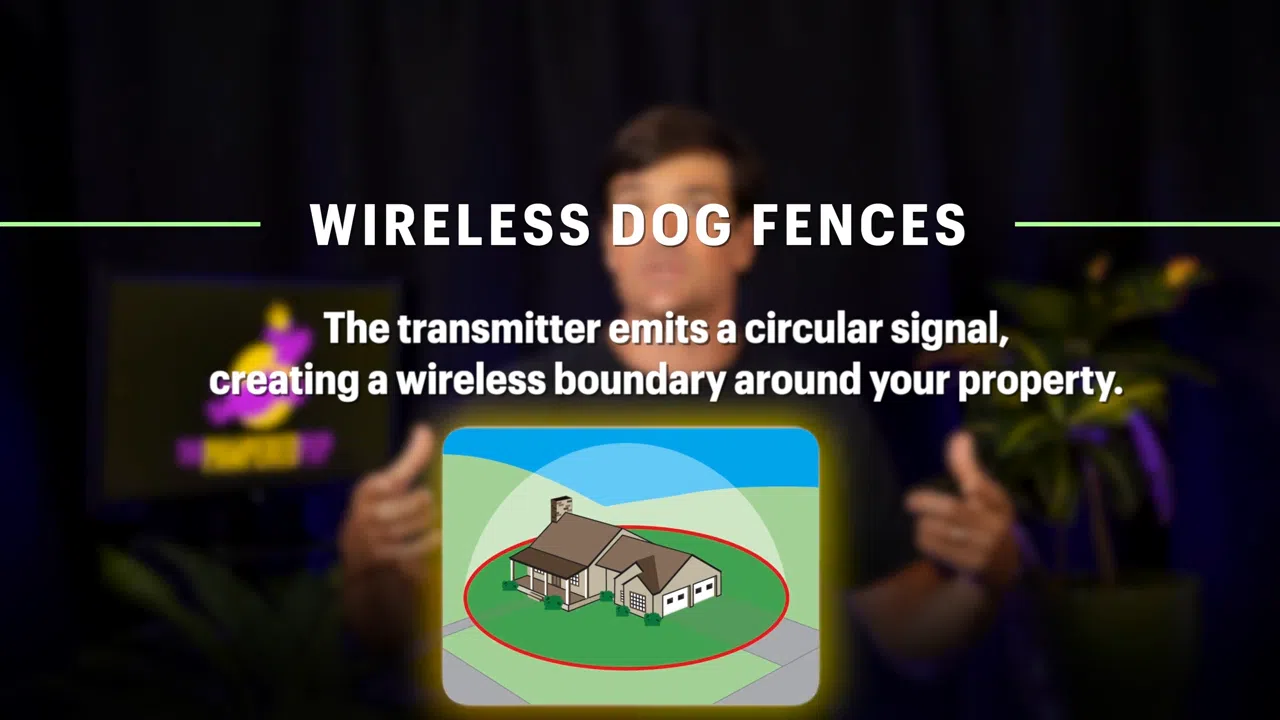
A wireless dog fence uses a central transmitter that emits a radio signal, creating a circular boundary. The receiver collar detects the signal edge and warns the dog. Wireless fences are the simplest to set up (plug in, adjust range) but only create circular boundaries with a maximum range of about half an acre. For a full breakdown, see our wireless dog fence comparison.
What is an in-ground invisible dog fence?
An in-ground dog fence uses buried wire around your property perimeter connected to a transmitter. The wire creates a signal boundary that the collar detects. In-ground fences are the most precise (the boundary is literally where you buried the wire) but require significant installation effort and aren’t portable. If your buried wire breaks, see our guide on how to find a break in an underground fence.
Which Invisible Fence Is Best for My Yard Size?
If your yard is under half an acre, choose PetSafe Wireless or Halo. If it’s over half an acre, choose SpotOn GPS. Yard size is the single biggest factor in choosing an invisible fence type.
- Under 900 sq ft: PetSafe Wireless is your only invisible fence option. GPS fences need more space for accurate satellite positioning.
- 900 sq ft to 1/3 acre: Halo Collar 5 works down to 900 sq ft. PetSafe Wireless also works here. See our best dog fence for small yards guide for detailed recommendations.
- 1/3 acre to 1/2 acre: All three types work. SpotOn, Halo, and PetSafe are all viable.
- Over 1/2 acre: GPS only. PetSafe’s radio signal maxes out at half an acre. SpotOn handles properties up to 100,000+ acres.
How Accurate Are Invisible Dog Fences?
GPS invisible fences average 8 to 25 inches of correction drift in our testing, depending on the brand. In-ground fences are the most precise since the boundary is the buried wire itself. Wireless fences have 1-3 feet of drift from the transmitter’s circular signal.
How accurate is SpotOn?
SpotOn Nova averaged 8 inches of correction drift with a 16.6-inch standard deviation across 5 tape-measured trials under partial tree cover. Every feedback stage — alert, warning, and correction — fired on every trial. That’s the tightest GPS accuracy we’ve measured. For full trial-by-trial data, see our SpotOn GPS Fence review.
How accurate is Halo?
Halo Collar 5 averaged 25 inches of correction drift with a 79.8-inch standard deviation under the same testing conditions. The final correction fired every time, but the intermediate warning tone missed on 2 of 5 trials. For open suburban terrain without heavy tree cover, Halo delivers reliable containment. For the full breakdown, see our Halo Collar review.
Do Invisible Dog Fences Really Work?
Yes, but they are a training tool — not a set-it-and-forget-it solution. Proper boundary training takes 1 to 4 weeks of short daily sessions. The technology works; success depends on how consistently you train. For our full analysis with reliability data across all brands, see do invisible dog fences actually work.
How does boundary training work?
GPS fences use progressive warnings: alert tone, then vibration, then static correction. Each stage fires at a different distance from the boundary, giving your dog multiple chances to turn back. In our testing, SpotOn fired all three stages on every trial. Your dog hears the tone, feels the vibration, and learns to turn around before correction ever happens. For a full training walkthrough, see our guide on how to train your dog to stay in the yard.
What happens if my dog runs through the fence?
If your dog ignores all warning stages and crosses the boundary, GPS fences send escape notifications to your phone and enable real-time tracking. Traditional wireless and in-ground fences don’t have this capability. If your dog is running through a PetSafe-style fence, see our troubleshooting guide for dogs running through invisible fences.

Are Invisible Dog Fences Humane?
When used correctly with proper training, invisible dog fences are safe. GPS fences offer the best safety features with multiple warning stages before any correction. We recommend starting with tone-only mode for all dogs.
I’ve strapped several invisible fence collars on my own neck to test the static correction levels. The static correction is painful — which is exactly why I can’t advocate jumping straight to it. Most systems don’t require that you do. SpotOn and Halo both support tone-only and vibration-only modes.
For the full data on correction levels and our recommendations, read our deep dive on whether invisible dog fences are actually humane.
In-Ground vs Wireless vs GPS Fence: Cost Comparison
Invisible dog fences range from about $250 for a basic wireless system to $999 for a premium GPS fence. Here’s how the costs break down across all three types, including long-term subscription costs and additional collars.
| Type | Upfront Cost | Subscription | 3-Year Total | Additional Collars |
|---|---|---|---|---|
| SpotOn GPS | $919 (w/ discount) | Optional ($7-$10/mo) | $919-$1,279 | $919 each |
| Halo GPS | From $524 | Mandatory ($7-$20/mo) | $776-$1,244 | $524+ each |
| PetSafe Wireless | From $250 | None | $250 | ~$145 each |
| In-Ground | $200-$500 + install | None | $200-$500 | ~$100-$150 each |
| Physical Fence (2 acres) | $3,000-$10,000+ | None | $3,000-$10,000+ | N/A |
Are invisible fences cheaper than physical fences?
For properties over half an acre, always. Physical fencing for a 2-acre property runs $3,000-$10,000+ depending on materials and labor. Even the most expensive GPS fence (SpotOn at $919) is a fraction of that cost, with the added advantage of being invisible, portable, and adjustable.
Which invisible fence has the best value for multi-dog households?
Wireless and in-ground systems have a significant advantage for multi-dog households. Additional collars cost roughly $145 each and pair to the same transmitter — no extra subscription. GPS fences require a separate full-price collar per dog. For two dogs on SpotOn, you’re looking at $1,838 versus about $395 for two dogs on PetSafe. For help setting up a multi-dog PetSafe system, see our guide on how to add a second collar to PetSafe.

90-day money-back guarantee. Discount appears at checkout after selecting your plan.
What Should You Consider Before Buying an Invisible Fence?
The five most important factors are yard size, boundary shape, portability, tree cover, and budget. Here’s a quick decision framework.
Does your yard shape matter?
Yes. Wireless fences only create circles — you can’t exclude driveways, pools, or garden beds. GPS fences let you trace any shape with up to 1,500 fence posts. In-ground fences follow whatever shape you bury the wire in. If your property is irregularly shaped or has areas you need to exclude, wireless is off the table.
Do invisible fences work under trees?
GPS fences can work under trees, but accuracy varies by brand. SpotOn averaged 8 inches of correction drift under partial tree cover. Halo averaged 25 inches under the same conditions. Wireless and in-ground fences are not affected by tree cover since they use radio signals. If you have heavy tree coverage, SpotOn is the best option based on our data.
Can you take an invisible fence on vacation?
GPS fences are fully portable — save unlimited fence configurations and take the collar anywhere. SpotOn works off-grid without cell service, making it ideal for camping and vacation properties. Wireless fences need a power outlet for the transmitter but are reasonably portable. In-ground fences are permanently installed and cannot be moved.
What about dogs with small necks?
GPS collars are bulkier because they house GPS antennas. SpotOn requires a minimum 10-inch neck. Halo fits necks from 8 inches. PetSafe fits necks from 8 inches and dogs over 8 pounds. If you have a small dog, Halo or PetSafe are better choices than SpotOn for collar fit.
Our Top 3 Invisible Dog Fence Picks
1. Best Overall: SpotOn GPS Fence (93/100 Fence Score)
SpotOn is the most accurate invisible dog fence we’ve tested. It averaged 8 inches of correction drift, fired every warning stage on every trial, and requires no subscription for containment. It works on properties from 1/3 acre to 100,000+ acres and supports unlimited saved fence configurations.
SpotOn built the GPS dog fence market. Their product engineering produces the most reliable GPS collar we’ve worked with — the boundary fires where you set it, every time.
90-day money-back guarantee. Discount appears at checkout after selecting your plan.
2. Best Runner-Up: Halo Collar 5 (64/100 Fence Score)
Halo Collar 5 delivers 100% final correction reliability at roughly half SpotOn’s upfront cost. It missed some intermediate warning tones under tree cover (2 of 5 trials), but the final correction — the one that actually stops your dog — fired every time.
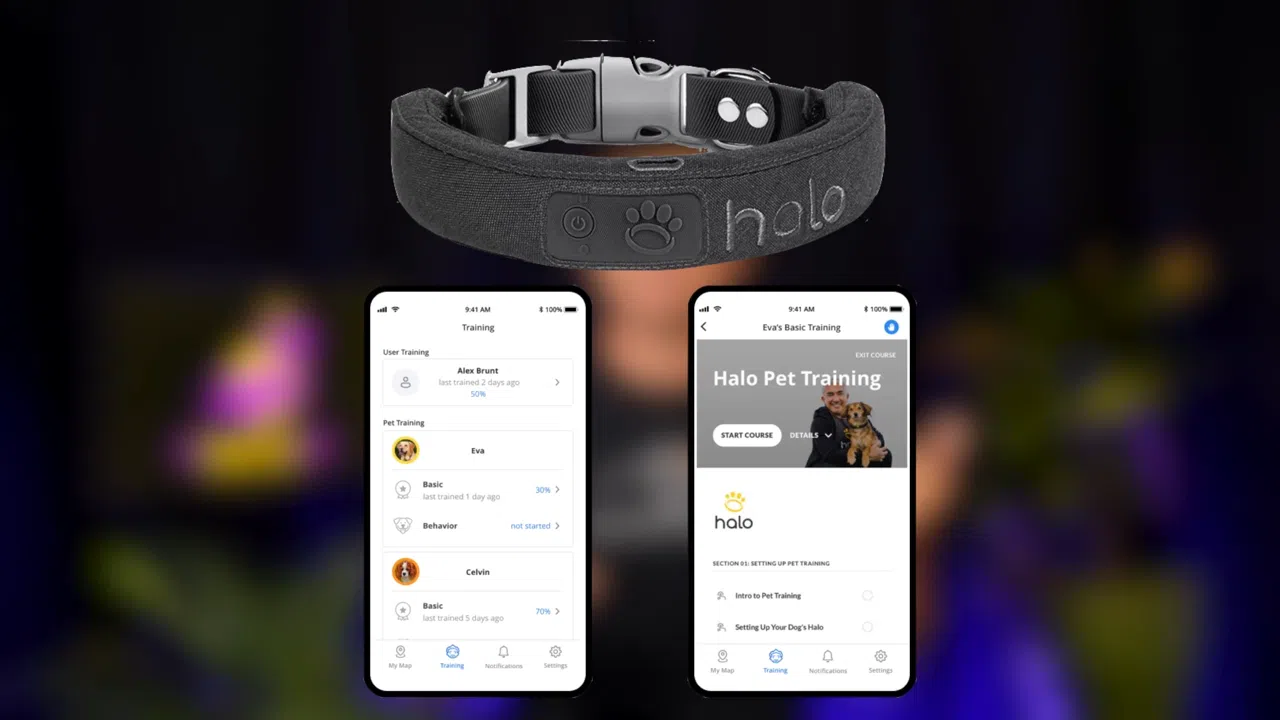
Halo wins over SpotOn on app quality (real-time tracking is genuinely better), collar size (fits necks from 8 inches), minimum property size (900 sq ft), and the built-in Cesar Millan training program. The trade-off is a mandatory subscription and wider correction drift.
3. Best Budget: PetSafe Wireless Pet Containment System
PetSafe is the best invisible fence for buyers who want simple, affordable containment for a small yard. It creates a circular boundary up to half an acre, sets up in minutes, and costs roughly $250 with no subscription.
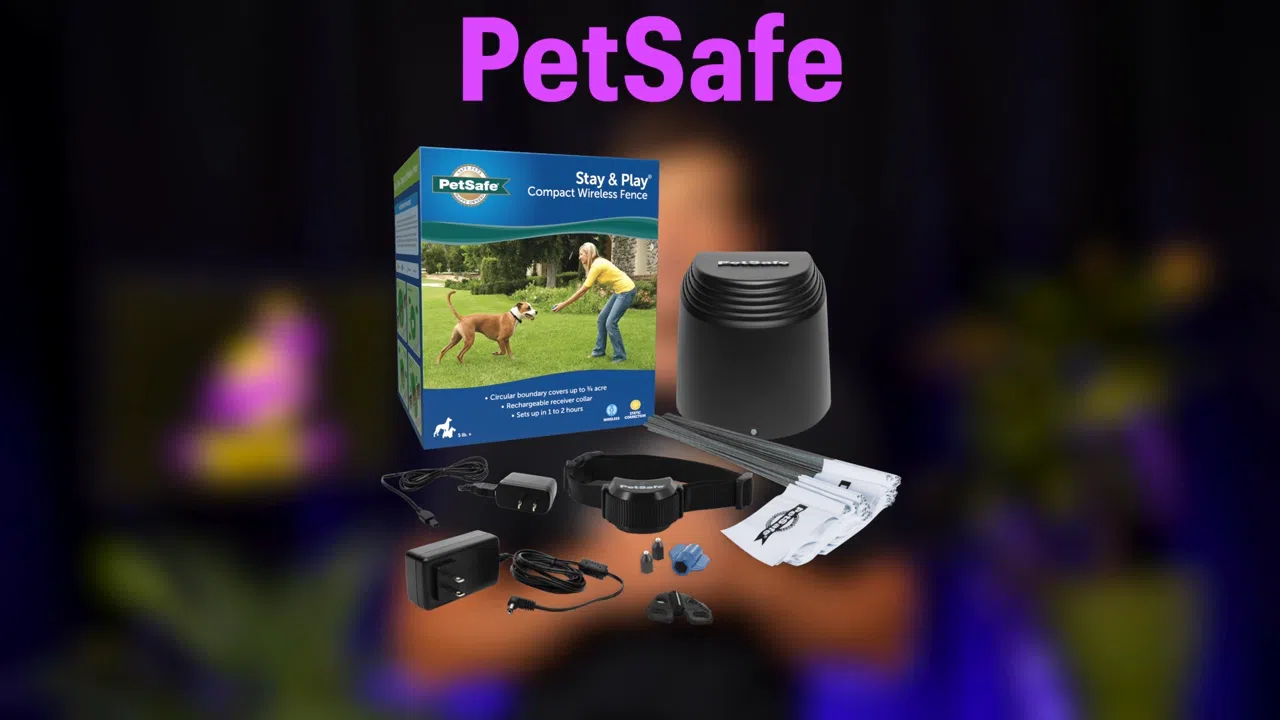
The trade-off: the boundary is always a circle, the warning before correction is brief, and there’s no GPS tracking or escape notification. For a detailed look at PetSafe’s strengths and limitations, see our full PetSafe Wireless review. If your PetSafe fence stops working, see our PetSafe troubleshooting guide.
Use code PUP10 ($10 off $100), PUP30 ($30 off $200), or PUP60 ($60 off $300) at checkout.
Reviewer: Zach Lovatt (95+ hours of invisible dog fence testing across GPS, wireless, and in-ground systems)
Testing date: November 2025 · Conditions: Partial tree cover
Scoring: Pampered Pup Fence Score (Accuracy 35 + Consistency 30 + Warning Reliability 25 + Cost 10 = 100)
Method: Tape-measured walk-the-line testing, 5 trials per feedback stage
Disclosure: This page contains affiliate links. Our testing methodology and scores are independent of affiliate relationships.
Full methodology: How We Test GPS Dog Fences
Frequently Asked Questions
What is the best invisible dog fence?
Based on our testing, the SpotOn GPS Fence is the best invisible dog fence overall. It scored 93 out of 100 on the Pampered Pup Fence Score with 8 inches of average correction drift and zero missed warnings across all trials. It works without a subscription for containment and handles partial tree cover. For smaller budgets, the Halo Collar 5 scored 64 out of 100 and costs about half upfront.
What is the best invisible fence for a small yard?
For yards under one-third of an acre, the Halo Collar 5 is the best invisible fence. It works on properties as small as 900 square feet and fits dogs with necks as small as 8 inches. GPS fences like SpotOn require a minimum of one-third of an acre. For yards under half an acre where a circular boundary works, the PetSafe Wireless Pet Containment System is the most affordable option.
Do invisible dog fences really work?
Yes, but they are a training tool, not a set-it-and-forget-it solution. Proper boundary training takes 1 to 4 weeks of short daily sessions. GPS fences like SpotOn and Halo use progressive warnings including tone, vibration, and then static correction to teach your dog where the boundary is. In our testing, SpotOn fired every warning stage on every trial. The technology works, but success depends on consistent training.
Are invisible dog fences safe for dogs?
When used correctly with proper training, invisible dog fences are safe. GPS fences offer the best safety features with multiple warning stages before any correction. We recommend starting with tone-only mode and only increasing if the dog does not respond. Static correction should be a last resort. SpotOn and Halo both support tone-only and vibration-only modes.
What is the best invisible fence for a large property?
SpotOn GPS Fence. It supports properties from one-third of an acre to over 100,000 acres, allows up to 1,500 fence posts per boundary, and works off-grid without cell service. It scored 93 out of 100 on the Pampered Pup Fence Score. No other invisible dog fence matches this range and flexibility for large properties.
How much does an invisible dog fence cost?
Traditional wireless and in-ground systems start around 300 dollars. GPS dog fences range from about 524 dollars for Halo Collar 5 to 999 dollars for SpotOn, or 919 dollars with our exclusive discount. Some GPS fences require monthly subscriptions at 7 to 20 dollars per month. SpotOn does not require a subscription for containment.
What is the difference between GPS and wireless invisible fences?
GPS invisible fences use satellite positioning to create custom-shaped virtual boundaries anywhere. Wireless invisible fences use a radio transmitter to create a fixed circular boundary from a central unit. GPS fences are more accurate, portable, and customizable but cost more. Wireless fences are simpler and cheaper but limited to circular boundaries under half an acre.
Do invisible fences work under trees?
GPS invisible fences can work under trees, but accuracy varies by brand. SpotOn averaged 8 inches of correction drift under partial tree cover in our testing. Halo averaged 25 inches under the same conditions. Traditional wireless and in-ground fences are not affected by tree cover since they use radio signals rather than GPS satellites.
Can you use an invisible fence with multiple dogs?
Yes. Wireless and in-ground systems support unlimited additional collars at about 145 dollars each. GPS fences require a separate full collar per dog. SpotOn costs 919 dollars per collar with discount. For multi-dog households, traditional systems have a significant cost advantage over GPS.
What is the difference between a wireless fence and an invisible fence?
A wireless fence is one type of invisible fence — not a separate product. “Invisible fence” is the umbrella term for any dog containment system that doesn’t use a physical barrier. There are three types: GPS fences (satellite-based virtual boundaries you draw on an app), wireless fences (a radio transmitter creating a circular boundary from a base station), and in-ground fences (buried wire around your property). The brand name “Invisible Fence” adds to the confusion — it’s one specific company that sells in-ground wire systems, not a description of all invisible fences.
What should I buy instead of Invisible Fence brand?
The SpotOn NOVA GPS Dog Fence is the best alternative to the Invisible Fence brand. It scored 93/100 on the Pampered Pup Fence Score, requires no buried wire, no professional installation, and no mandatory subscription for containment. It costs $919 with our discount versus $2,000-$3,500 for a typical Invisible Fence brand installation. For a full cost and performance comparison across all alternatives, see our guide to Invisible Fence alternatives.
What is the best invisible dog fence without a monthly fee?
SpotOn NOVA is the best GPS invisible dog fence without a mandatory monthly fee. The containment fence works forever at the $919 purchase price (with our discount) — no subscription required. There’s an optional GPS tracking plan ($7-$10/mo) if you want real-time location alerts, but the fence itself doesn’t need it. PetSafe Wireless also has no monthly fee but is limited to circular boundaries under half an acre. In-ground fences have no monthly fee but require professional installation.
What is the best invisible fence for escape artists?
For dogs that bolt, chase, or run through fences due to high prey drive or anxiety, the SpotOn NOVA is the best option. It delivered corrections on 100% of trials with only 8 inches of average drift — the boundary fires before your dog crosses the line. It also sends real-time escape alerts to your phone and GPS tracking lets you locate them immediately. Halo Collar 5 also hit 100% on final corrections and includes GPS tracking, making it a solid runner-up for escape-prone dogs.
Does a GPS dog fence work without cell service?
SpotOn is the only GPS fence we’ve tested that works without cell service. Its core containment runs entirely on GPS satellites and the collar’s onboard processor — no cellular connection required. This makes it the best option for rural properties, farms, and cabins with poor or no cell coverage. See our off-grid testing results for the full data. Halo Collar requires cell or Wi-Fi service for its containment features to function.