
Dense Woods GPS Fence Tests
Dense tree cover is where GPS dog fences fail. Satellite signals scatter, bounce, and weaken under canopy — and most backyards have trees. We ran a controlled stress test under approximately 50% pine canopy to find out which GPS fences can handle it and which can't. Two of the four collars we tested delivered usable containment. One failed 40% of the time. One failed every single trial.
Why Dense Cover Testing Matters
Most manufacturer accuracy claims come from open-sky testing — ideal conditions few backyards actually have. GPS signals degrade under tree canopy through multipath reflection, signal attenuation, and fewer visible satellites. A fence that works in an open field but fails under trees is a fence that fails in your yard.
Dense cover (approximately 50% pine canopy) is the hardest common GPS condition — not a fringe scenario. If a GPS fence works here, it'll work almost anywhere residential. That's why we chose these conditions for our head-to-head stress test. We wanted to know which collars break under pressure, and our Fence Score methodology demands real-world data, not lab results.
The July 2025 Stress Test
All four collars were tested on the same property, same day, under identical dense tree cover — no test-condition differences to argue about. The collars tested were SpotOn Omni, Halo Collar 4, PetSafe Guardian 2.0, and Satellai.
These were previous-generation models. SpotOn Omni is now replaced by the Nova, and Halo 4 by Collar 5. We include these results because the test protocol was identical across all four collars and because the data reveals critical reliability differences under stress.
We used the same tape-measured protocol for every collar: a physical rope boundary, colored flags to mark where each correction fired, and 5 trials per collar. Every drift measurement was tape-measured, not estimated. For the full breakdown of our accuracy testing protocol, we document every step.
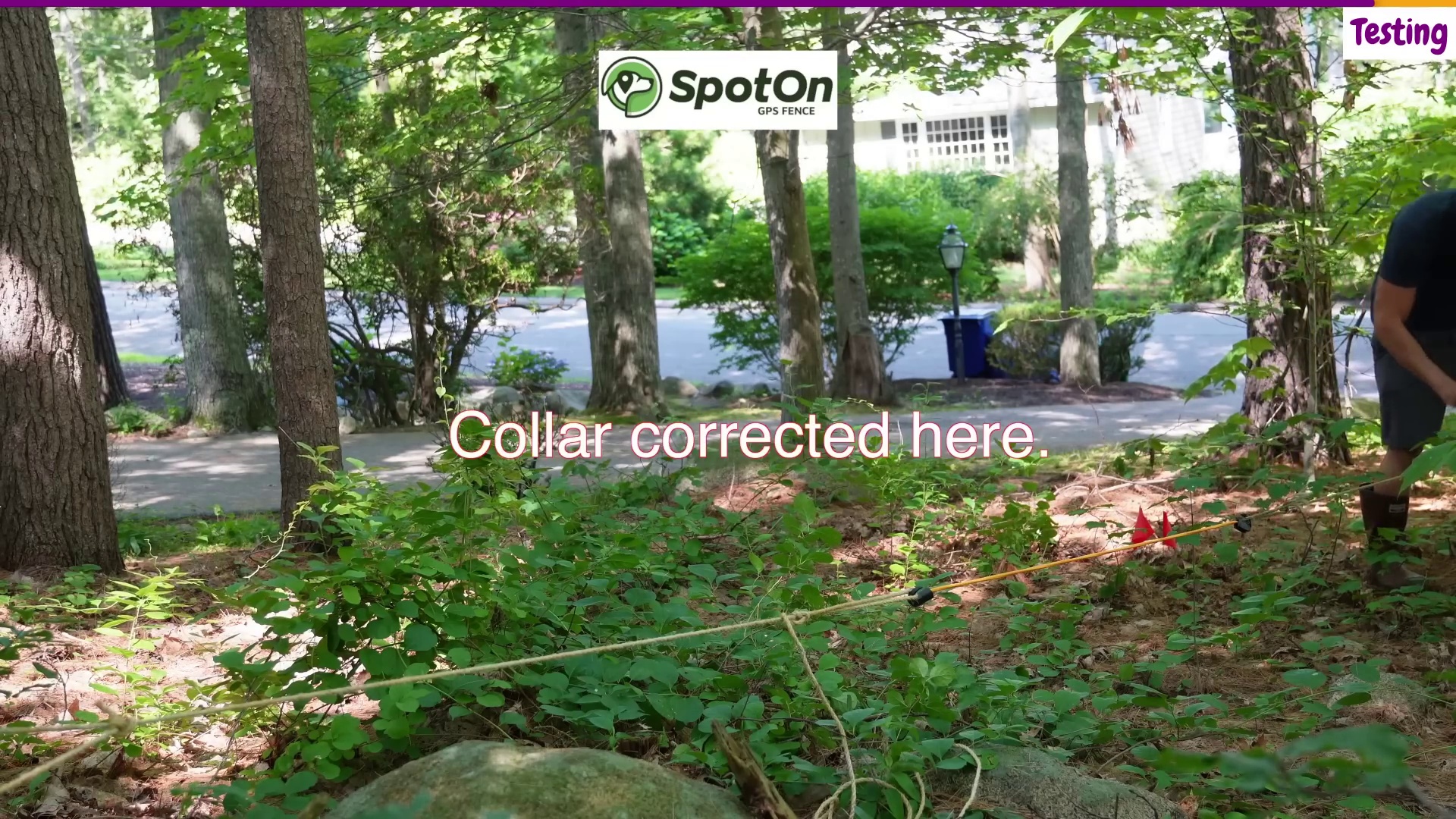 Rope boundary line and colored flags marking exact correction points during our dense-cover stress test.
Dense Cover Results
| SpotOn Omni | Halo Collar 4 | PetSafe Guardian | Satellai | |
|---|---|---|---|---|
| Correction Fired | 100% (5/5) | 100% (5/5) | 60% (3/5) | 0% (0/5) |
| Avg Correction Drift | −38.7" | +43.1" | −40.2" (3/5 working) | N/A |
| Past Boundary | 3/5 | 2/5 | 2/3 working | N/A |
What Each Result Means
SpotOn Omni
Fired the correction on every trial — the most important thing. Accuracy was mixed under these extreme conditions (−38.7" average drift, 3 out of 5 past boundary), but the collar never failed to respond. The newer SpotOn Nova performs significantly better under partial tree cover (8" average drift).
Halo Collar 4
Also achieved 100% correction reliability — credit where it's due. Average drift of +43.1" is wide, but the positive sign means most corrections fired inside the boundary (safer). Map-based boundary setup contributes some of that offset.
PetSafe Guardian
A 40% complete failure rate — no warning, no correction, nothing on 2 out of 5 trials. On the 3 trials that worked, correction drift ranged from +8.75" to −96.5". The combination of failures and unpredictable drift makes it unreliable under tree cover. We break this down further in our SpotOn vs PetSafe Guardian comparison.
Satellai
100% failure rate — zero feedback on all 5 trials. The collar did not respond to boundary crossings at all under dense cover.
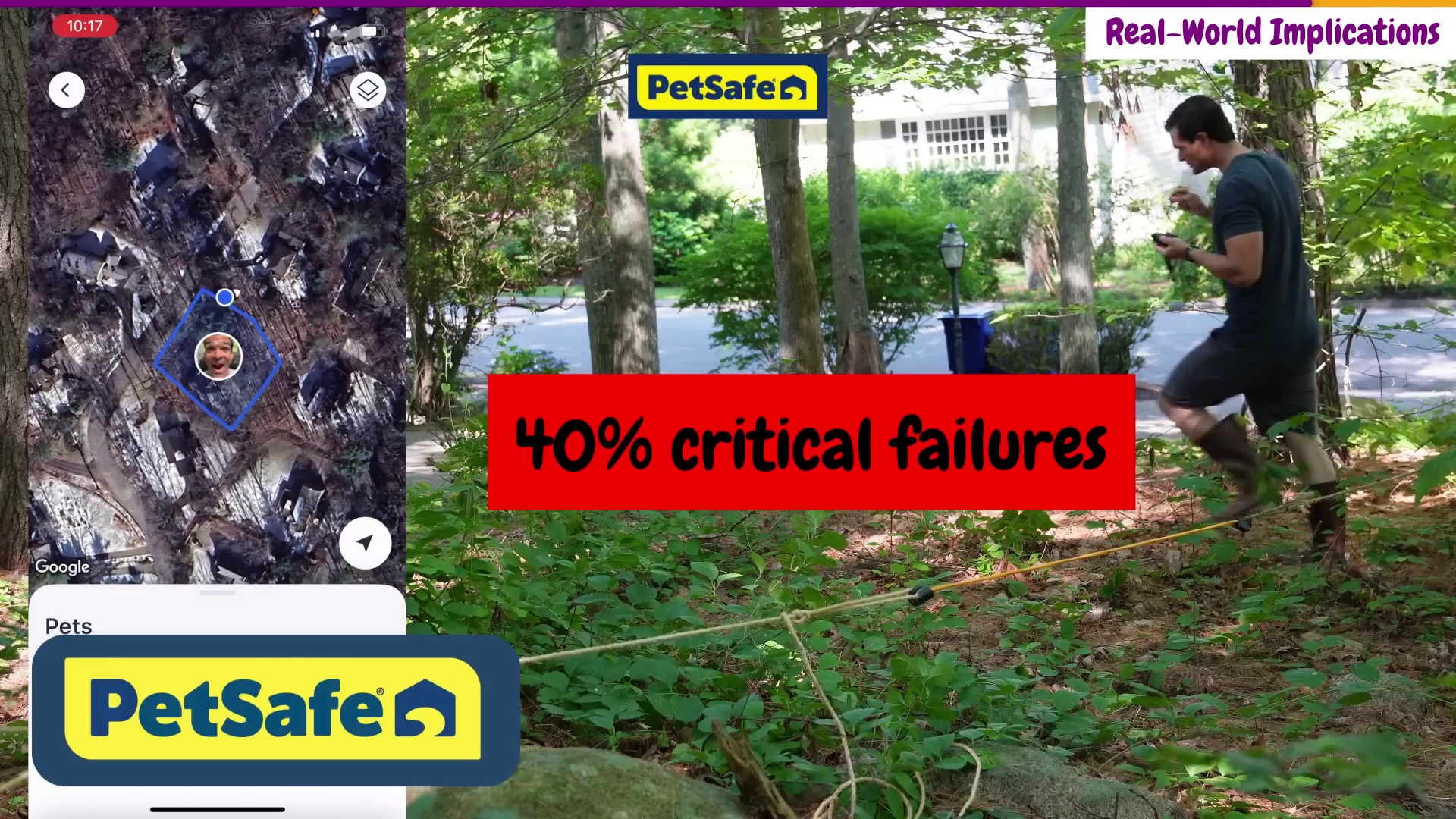 PetSafe Guardian testing under dense tree cover — 2 out of 5 trials produced zero response.
Dense Cover vs Partial Cover
The newer models — SpotOn Nova and Halo 5 — were tested under partial tree cover and performed considerably better than the older hardware under dense canopy.
- SpotOn Nova (partial cover): 8" average drift, 16.6" standard deviation
- Halo 5 (partial cover): 25" average drift, 79.8" standard deviation
We haven't tape-measured the Nova under dense cover yet — that test is planned. We don't extrapolate results across conditions because GPS performance is highly environment-dependent. The dense-cover data above tells you about dense cover. The partial-cover data tells you about partial cover. Mixing them would be dishonest.
For collar performance outside cellular range, our off-grid testing results cover that scenario separately.
What This Means for Your Yard
If your property has moderate to heavy tree cover, SpotOn and Halo are the only GPS fences with 100% correction reliability in our dense-cover testing. PetSafe and Satellai are not recommended for properties with significant tree cover.
Even in dense cover, both SpotOn and Halo delivered the final correction on every trial — no dog would have escaped. Accuracy suffers under dense canopy for all collars, but reliability (does it fire at all?) is the critical safety factor. An inaccurate fence that always fires is manageable with buffer zones. A fence that sometimes doesn't fire at all is a containment failure.
For a broader look at how every collar ranks across all our testing conditions, see our complete GPS dog fence rankings.
Tested by: Zach Lovatt · Date: July 2025 · Conditions: Dense tree cover (~50% pine canopy)
All four collars tested on same property, same day, identical methodology
SpotOn Omni and Halo Collar 4 are previous-generation models (replaced by Nova and Collar 5)
Method: Tape-measured boundary testing, 5 trials per collar, walk-and-mark with collar in hand
Note: SpotOn uses walk-the-line setup. Others use map-based placement. PetSafe uses two-stage system (alert + correction only).