What Is the Best Wireless Dog Fence? Tested & Compared (2026)


The best wireless dog fence is the SpotOn GPS Fence. It scored 93/100 on the Pampered Pup Fence Score — the highest of any wireless dog fence we’ve tested. In our tape-measured boundary testing, SpotOn averaged 8 inches of correction drift with a 16.6-inch standard deviation. The Halo Collar 5 averaged 25 inches of drift with a 79.8-inch standard deviation — nearly 5× the variability. No subscription required for containment.
We measured these numbers across 95+ hours of testing with colored flags, a physical rope boundary, and a tape measure. Below, I break down GPS vs radio wireless fences, where the cheap option fails, and which wireless dog fence is actually worth your money.
Your discount auto-applies at checkout after selecting your plan.
What Is a Wireless Dog Fence?
A wireless dog fence is a containment system that keeps your dog inside a boundary without any physical fencing or buried wire. The term covers two very different technologies, and knowing the difference is the whole ballgame.
GPS wireless fences communicate with satellites. Your dog’s collar determines its position via GPS, and you draw whatever boundary shape you need directly on a map — your actual yard, your actual property line. The collar enforces it with progressive warnings. You get an app, real-time tracking, and escape alerts. SpotOn and Halo are both GPS wireless fences.
Radio wireless fences use a transmitter that sits inside your house and broadcasts a signal outward in a fixed circle. Your dog wears a receiver collar — get close to the edge, they get a warning. Keep going, correction. No wire, no digging. The catch: it only creates one fixed circle and depends entirely on the signal staying clean. PetSafe Wireless is a radio fence.
Both are sold as wireless fences. They are not the same thing. Which one you need depends on your yard size and dog. For a broader look at all containment types including in-ground systems, see our best invisible dog fence comparison.

Best Wireless Dog Fence Reviews (2026)
| SpotOn GPS Fence | Halo Collar 5 | PetSafe Wireless | |
|---|---|---|---|
| Fence Score | 93/100 | 64/100 | N/A (radio) |
| Type | GPS (satellite) | GPS (satellite) | Radio (transmitter) |
| Correction Drift | 8” average | 25” average | N/A |
| Consistency | ±16.6” std dev | ±79.8” std dev | Unreliable with obstacles |
| Subscription | Not required for fence | Mandatory | None |
| Price | $919 with discount | $600 + monthly fee | $200 |
PetSafe Wireless is a radio-based system and cannot be scored under our GPS tape-measured methodology. The Pampered Pup Fence Score applies only to GPS fences tested with our boundary accuracy protocol.
| GPS Fence | Score | Band | Reliability /30 |
Consistency /30 |
Accuracy /25 |
Warnings /15 |
|---|---|---|---|---|---|---|
| SpotOn Nova | 93/100 | Exceptional | 30 | 25 | 23 | 15 |
| Halo Collar 5 | 64/100 | Mixed | 30 | 6 | 19 | 9 |
| PetSafe Guardian | 42/100 | Weak | 18 | 0 | 15 | 9 |
| Satellai | 0/100 | Failing | 0 | 0 | 0 | 0 |
Scoring Formulas
| Component | Weight | Formula | What It Measures |
|---|---|---|---|
| Reliability | 30 pts | (corrections fired ÷ total trials) × 30 | Did the collar fire the final correction? |
| Consistency | 30 pts | 30 × (1 − std dev ÷ 100) | How predictable is the correction location? |
| Accuracy | 25 pts | 25 × (1 − avg drift ÷ 100) | How close to the boundary did it fire? |
| Warning Completeness | 15 pts | (full-sequence trials ÷ total trials) × 15 | Did every designed warning stage fire? |
Scale anchor: 100 inches (≈ 8 feet). At this level of drift or standard deviation, the correction zone spans a typical road setback — the fence cannot be trusted near hazards. Drift or deviation at or above 100” scores zero for that component.
Consistency eligibility: Collars that failed to fire the correction on any trial score 0 for Consistency. If the collar doesn’t always fire, the sample is too unreliable to assess predictability.
Score Bands
| Score | Band | What It Means |
|---|---|---|
| 90–100 | Exceptional | Reliable, consistent, and accurate. Safe near hazards. |
| 70–89 | Strong | Reliable containment with manageable trade-offs. |
| 50–69 | Mixed | Contains but consistency or warning coverage has gaps. |
| 25–49 | Weak | Frequent failures or insufficient data. Not recommended as sole containment. |
| 0–24 | Failing | Did not deliver functional containment in testing. |
Tested by: Zach Lovatt · SpotOn Nova: November 2025 · Halo Collar 5: September 2025 · PetSafe Guardian & Satellai: July 2025
SpotOn Nova & Halo Collar 5: Partial tree cover · PetSafe Guardian & Satellai: Dense tree cover (deliberately harder conditions — PetSafe's accuracy and consistency would likely score higher under partial tree cover)
Method: Tape-measured boundary testing, 5 trials per collar, walk-and-mark with collar in hand
Formulas: Reliability = (corrections ÷ trials) × 30. Consistency = 30 × (1 − std dev ÷ 100), requires 100% fire rate. Accuracy = 25 × (1 − |avg drift| ÷ 100). Warning Completeness = (full-sequence trials ÷ trials) × 15. Scale anchor = 100" (≈ 8 ft).
Note: SpotOn uses walk-the-line boundary setup (fence aligns with rope). Halo, PetSafe, and Satellai use map-based placement (potential alignment gap). PetSafe uses a two-stage warning system (alert + correction only, no intermediate warning vibration) — this is a design choice, not a scored failure.
1. SpotOn GPS Fence — Our Top Pick (93/100)
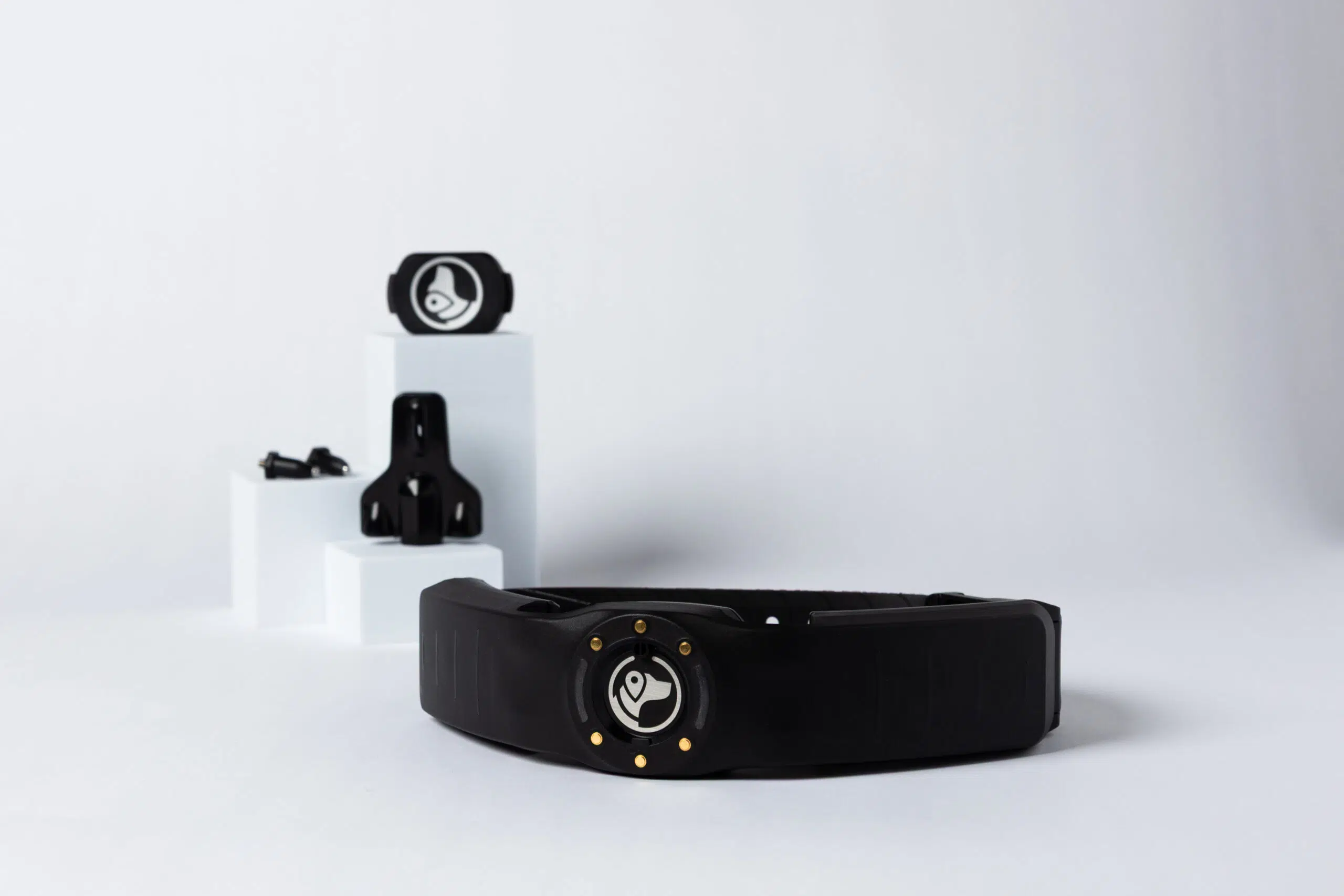
Best for: Properties with tree cover, irregular yard shapes, homes near roads, rural or large acreage, and dog owners who want no monthly fees.
SpotOn is the most accurate GPS fence we’ve tested, and the reason is documented. In our boundary testing under partial tree cover, SpotOn averaged 8 inches of correction drift with a standard deviation of 16.6 inches. Halo averaged 25 inches with a standard deviation of 79.8 inches. No missed alerts, no doubled alerts across five trials. That’s not a marketing claim — that’s what we measured in our own repeated testing.
What sets SpotOn apart:
- No subscription required for the fence. You buy the collar, draw your boundary, and it works permanently. There’s an optional subscription for live tracking and additional features, but the fence itself is yours. Over the life of the product, that difference adds up significantly compared to Halo’s mandatory subscription.
- Works on any property size. From a third of an acre up to 100,000 acres. You can draw your fence on a map or physically walk your property line — whichever is easier.
- 8 inches of correction drift. Across five trials, every warning, every correction fired — zero misses. Halo’s 25-inch average under the same conditions tells you why this gap matters.
The tradeoff is the upfront price. A thousand bucks is real money. But here’s how I’d frame it: a single emergency vet visit after a car accident costs more than this collar. What you’re buying is a system that holds the boundary every single time in conditions where cheaper systems don’t.
If you’ve already been through the frustration of a fence that doesn’t work reliably, or if you can’t afford to find out the hard way, SpotOn is the answer.
CLICK HERE: Get SpotOn GPS Fence — $80 OFF →
→ See how SpotOn compares head-to-head with Halo
2. Halo Collar 5 — Best Budget GPS Option (64/100)
Best for: Suburban yards with good connectivity, first-time GPS fence buyers on a budget, and dog owners who want built-in obedience training.
The Halo Collar 5 is the more accessible entry point into GPS containment, and it’s genuinely a good collar. I’ve tested it with my dog Kona, and once we had it synced — which did take a couple tries — she responded to it really well.
The app is totally solid. Battery life is impressive — 32 to 36 hours on a full charge, the best in this category. Setup took about 2.5 hours total, which is reasonable for what you’re getting.
Halo also comes with a built-in training program developed with Cesar Millan. If you just got a dog and want a collar that handles both obedience training and containment in one system, that’s a real feature, not fluff.
What to know before you buy Halo:
- Subscription required. Halo requires a monthly subscription to access GPS features. The collar price isn’t the whole cost — that monthly fee adds up over time.
- Intermediate warning gap. In our boundary testing, Halo was solid at the final correction level — it never missed a single one. But at the intermediate warning level, we saw missed alerts on some trials. The practical fix: set your boundary a little tighter than you think you need, especially in areas with tree cover.
Halo is a strong option. If the price point matters and you’re okay with a subscription, it belongs in your consideration set.
CLICK HERE: check for deals on the Halo Collar 5 →
3. PetSafe Wireless — Best for Small, Circular Yards (31/100)

Best for: Small, flat, circular yards with no trees or metal interference and a strict $200 budget.
The PetSafe wireless is the entry-level product in this space. It’s been around for years, and in a perfect scenario — circular yard, no significant tree cover, no metal roof — it can totally work.
The problem is that the perfect scenario isn’t most people’s yards.
I went through the one-star reviews on Chewy. There are 42 of them, and the thread is almost identical every single time:
- “Our neighborhood has too many trees.”
- “Beeps randomly, no uniformity. Need to return.”
- One reviewer described it working for about 2 weeks before their dog started walking straight through it.
- Multiple reviews mention the collar going off inside the house.
- The transmitter actually has to be placed in the middle of your home. The boundary is limited to roughly half an acre and the collar can’t be worn more than 12 hours a day.
One of our researchers had this hit close to home. His parents picked up this system, didn’t realize better options existed, and laughed when he mentioned GPS alternatives costing a few hundred dollars more. He visited months later and asked how it was going. They had stopped using it. Not returned it — just stopped. The collar’s in a drawer somewhere. $200 gone, and the dog still doesn’t have a reliable boundary.
That’s the most common outcome when this system doesn’t work out. You fight with it for a few weeks, it becomes inconsistent, and eventually it quietly stops being used. No dramatic failure — just slowly slides into “we gave up” mode.
If your yard genuinely is a circle, you have no trees to speak of, and $200 is your hard ceiling, this product exists and it works for some people.
CLICK HERE: Get my BEST DEAL on the PetSafe Wireless →
Do Wireless Dog Fences Actually Work?
Yes, but they are a training tool — not a set-it-and-forget-it solution. GPS wireless fences work reliably; radio-based wireless fences are hit or miss depending on your yard.
In our testing, SpotOn fired every warning stage on every trial — 100% reliability. Halo delivered final corrections on every trial but missed intermediate warnings on 2 of 5 runs. PetSafe’s radio-based system works in ideal conditions but fails with trees, metal interference, or non-circular yards.
The technology is the easy part. Proper boundary training takes 1 to 4 weeks of short daily sessions. GPS fences use progressive warnings — alert tone, then vibration, then static correction — giving your dog multiple chances to turn back before correction happens. For a full training walkthrough, see our guide on how to train your dog to stay in the yard.
For deeper reliability data across every brand, read our analysis: do invisible dog fences actually work?
Are Wireless Dog Fences Safe?
When used correctly with proper training, wireless dog fences are safe. GPS fences offer the best safety features with multiple warning stages before any correction. We recommend starting with tone-only mode for all dogs.
SpotOn and Halo both support tone-only and vibration-only modes, so you never have to use static correction if your dog responds to lighter cues. Static correction should be a last resort, not the starting point.
For our full analysis with correction level data and recommendations, read our deep dive on whether invisible dog fences are actually humane.
The Final Verdict: Which Wireless Dog Fence Should You Buy?
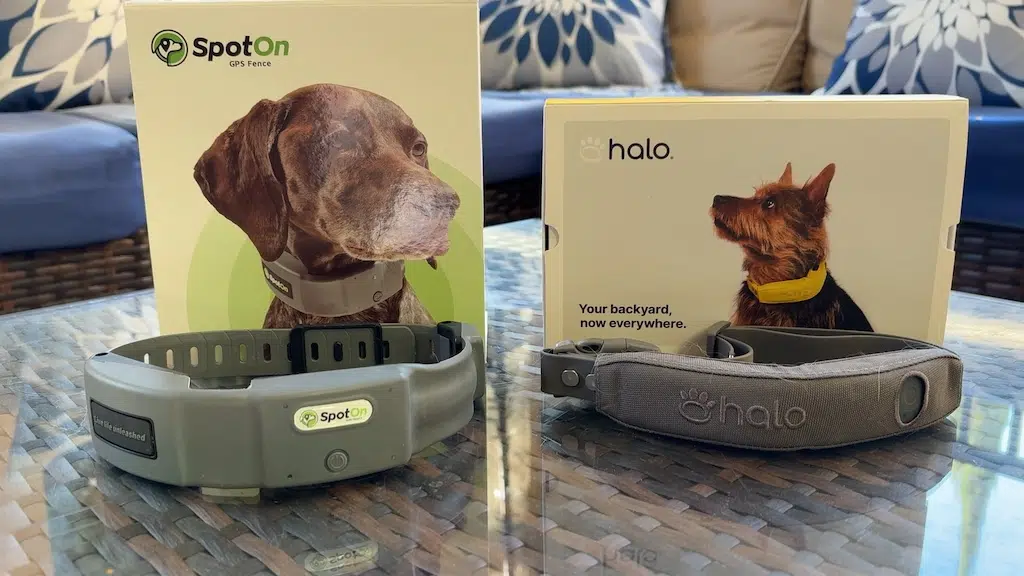
If your yard is simple, no tree cover, and you’re working with a strict $200 budget — the PetSafe wireless can work as long as you go in with realistic expectations.
If you want GPS flexibility at a lower upfront cost and you’re okay with a subscription — the Halo Collar 5 is a solid option, especially if you set your boundaries conservatively.
If you want the most reliable containment we’ve tested, no required subscription for the fence, and you’re willing to invest upfront — SpotOn is the one I personally trust with my own dog.
The sooner your dog is trained, the sooner they benefit from the system. If you’ve been on the fence about which one to trust, now you’ve got your answer.
CLICK HERE: Get SpotOn GPS Fence — $80 OFF →
CLICK HERE: check for deals on the Halo Collar 5 →
CLICK HERE: Get my BEST DEAL on the PetSafe Wireless →
Dense-Cover Stress Test (July 2025)
Tree cover is where GPS fences fail — and where the gap between brands becomes dangerous. In July 2025, we tested four GPS collars on the same property, same day, under identical dense tree cover (~50% pine canopy). No test-condition differences to argue about.
| SpotOn Omni | Halo Collar 4 | PetSafe Guardian | Satellai | |
|---|---|---|---|---|
| Correction Fired | 100% (5/5) | 100% (5/5) | 60% (3/5) | 0% (0/5) |
| Avg Correction Drift | −38.7” | +43.1” | −40.2” (3/5 working) | N/A |
| Past Boundary | 3/5 | 2/5 | 2/3 working | N/A |
SpotOn Omni and Halo Collar 4 are previous-generation models (replaced by Nova and Collar 5). Even the older SpotOn fired the correction on every trial. PetSafe Guardian failed 40% of the time — no warning, no correction, nothing. Satellai failed 100%. For the full breakdown, see our dense cover testing results.
Tested by: Zach Lovatt · Date: July 2025 · Conditions: Dense tree cover (~50% pine canopy)
All four collars tested on same property, same day, identical methodology
SpotOn Omni and Halo Collar 4 are previous-generation models (replaced by Nova and Collar 5)
Note: PetSafe uses a two-stage system (alert + correction only). Reliability measures final correction, not intermediate warning stages.
How We Tested These Wireless Dog Fences
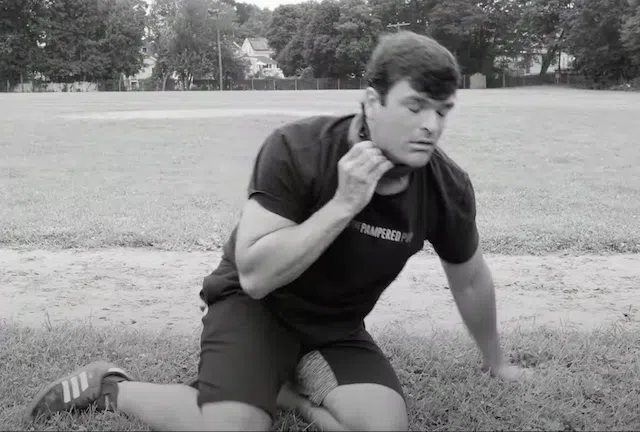
We tested every GPS wireless dog fence in this review on the same property under partial tree cover using a tape-measured, walk-the-line methodology. Zach walked each boundary with the collar in hand, bobbing it gently up and down to simulate a dog’s walking gait (some GPS systems use accelerometers, so a flat motionless carry would produce different results than real-world use). He marked exactly where each feedback stage fired with colored flags — green for alert, yellow for warning, red for correction — then tape-measured the distance from each flag to the physical boundary rope. Every product ran through 5 trials at each alert stage. For our full testing protocol, see the GPS accuracy testing page linked above.
What we measured: Correction drift — the distance between where the boundary is set and where the collar actually fires. Positive drift means the collar fired before the boundary (dog still inside). Negative drift means it fired past the boundary (potential escape). We also track standard deviation across trials and completion rate (whether the collar delivered any feedback at all).
Why standard deviation matters more than average: Average drift can hide wild inconsistency. A collar that fires at +80 inches one trial and −80 inches the next averages 0 inches — looks perfect on paper but is dangerously unpredictable. SpotOn’s 16.6-inch standard deviation means it fires in roughly the same spot every time. Halo’s 79.8-inch standard deviation means one trial might fire 8 feet early and the next 3 feet late. For a dog near a road, consistency is what keeps them safe.
Off-grid capability: SpotOn is the only GPS fence we’ve tested that runs core containment entirely on GPS satellites and the collar’s onboard processor — no cell service required. For full details, see our off-grid testing results.
What we didn’t test: SpotOn Nova has not been tape-measured under dense tree cover yet — only partial cover. We’ll update this review when those results are in. We don’t extrapolate results across conditions.
Frequently Asked Questions
What is the best wireless dog fence?
The best wireless dog fence is the SpotOn GPS Fence. In our 95+ hours of testing, SpotOn averaged 8 inches of correction drift — the fence fired within 8 inches of the actual boundary. The Halo Collar 5 averaged 25 inches of drift under the same conditions. SpotOn requires no subscription for core containment and works on properties from ⅓ acre to 100,000+ acres. For buyers on a tighter budget, the Halo Collar 5 is the best wireless dog fence under $600 with a mandatory subscription.
What is the best wireless fence for dogs with large yards?
For large yards and rural properties, the SpotOn GPS Fence is the best wireless fence for dogs. It supports properties up to 100,000+ acres with up to 1,500 fence posts per boundary. You can walk your property line and the collar automatically drops posts, or draw the fence on a map. No other wireless dog fence matches this range.
Do wireless dog fences actually work?
GPS wireless dog fences work reliably in real-world conditions. In our testing, SpotOn averaged 8 inches of correction drift and fired on every single trial — zero misses. The Halo Collar 5 averaged 25 inches of drift but still delivered final corrections on every trial. Traditional radio-based wireless fences (like PetSafe Wireless) work in ideal conditions — circular yards with no trees or metal interference — but fail frequently in yards with obstacles, tree cover, or irregular shapes.
What is the best wireless dog fence without a subscription?
The SpotOn GPS Fence is the best wireless dog fence that works without a subscription. The core containment features — boundary creation, warnings, and corrections — work permanently with no monthly fee. An optional subscription ($7.49–$9.95/month) adds live GPS tracking. By comparison, the Halo Collar 5 requires a mandatory subscription for all features, and the PetSafe Wireless has no subscription but limited capabilities.
How much does a wireless dog fence cost?
Wireless dog fence prices range from about $200 to $1,000. The PetSafe Wireless system costs around $200 but only creates circular boundaries. The Halo Collar 5 GPS fence runs about $524–$600 plus a required monthly subscription. The SpotOn GPS Fence costs about $999 ($919 with our discount) with no required subscription for containment. Over 3 years, the total cost of ownership between Halo and SpotOn is closer than the sticker price suggests once subscriptions are factored in.
What is the difference between a GPS dog fence and a wireless dog fence?
A GPS dog fence uses satellite positioning to create custom-shaped virtual boundaries — the collar communicates with satellites and enforces whatever shape you draw on a map. A traditional wireless dog fence uses a radio transmitter inside your home that broadcasts a circular signal outward. GPS fences are more accurate, portable, and flexible but cost $500–$1,000. Radio wireless fences are simpler and cheaper ($200) but limited to circular boundaries under half an acre. Both are marketed as “wireless dog fences,” which is why the distinction matters.
Do wireless dog fences work under trees?
GPS wireless dog fences can work under trees, but accuracy varies by brand. In our testing under partial tree cover, SpotOn averaged 8 inches of correction drift while Halo averaged 25 inches. Traditional radio-based wireless fences like PetSafe are not affected by tree cover since they use radio signals, but they have other reliability issues with obstacles and metal interference.
Can I use a wireless dog fence for multiple dogs?
Yes, but the cost structure varies. Traditional wireless fences like PetSafe support additional collars at about $145 each — all paired to the same transmitter. GPS fences require a separate full-price collar per dog. For two dogs on SpotOn, you’re looking at about $1,838 versus roughly $395 for two dogs on PetSafe. If you have multiple dogs on a budget, traditional wireless systems have a significant cost advantage.
Related: Best GPS Dog Fence | SpotOn vs PetSafe Guardian | PetSafe Wireless Review