
GPS Fence Accuracy Tests: Our Tape-Measured Protocol
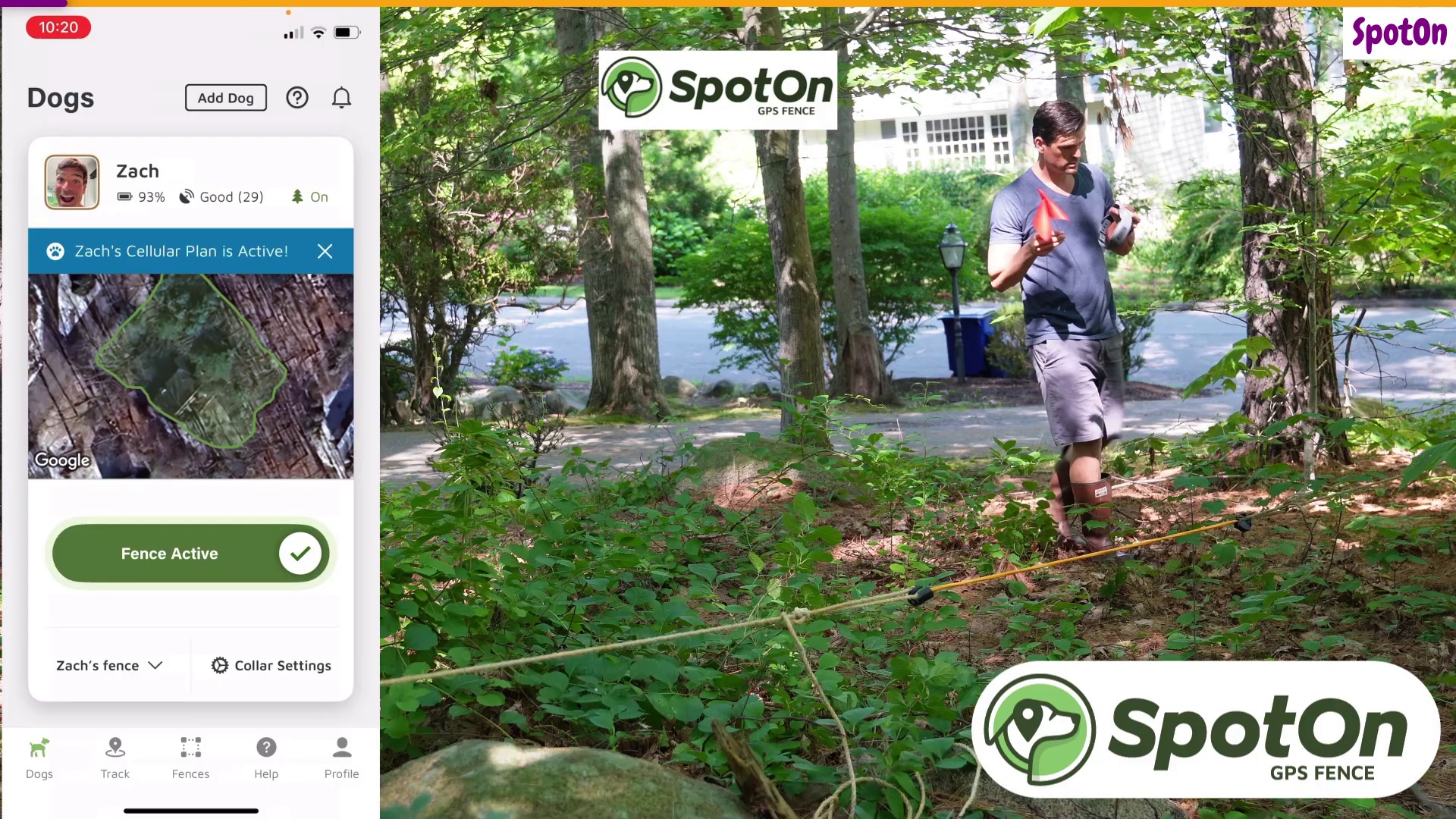
We don't guess where GPS fences fire — we measure. Every GPS dog fence we evaluate goes through our tape-measured boundary accuracy protocol: a physical rope boundary, colored flags marking where each feedback stage fires, and a tape measure to quantify the exact drift in inches. This page explains the protocol behind every accuracy number on our site.
Why Accuracy Testing Matters
GPS accuracy is the single most important factor in a GPS dog fence. An inaccurate fence is a dangerous fence — if the correction fires 6 feet past your boundary, your dog is already in the road before the collar responds. If it fires 6 feet inside, you're losing a significant chunk of usable yard for no reason.
Most GPS fence reviews base accuracy claims on manufacturer specs or casual walkthroughs. "It seemed pretty accurate" doesn't cut it when your dog's safety depends on the answer. We tape-measure every data point so our accuracy numbers come from physical evidence, not impressions.
The difference between collars is dramatic. In our testing, average correction drift ranged from 8 inches to over 43 inches — and one collar failed to fire at all. Those differences are invisible without a tape measure.
The Protocol
Here is exactly how we collect every accuracy data point on this site:
- Set a physical rope at the GPS boundary line. This rope is the ground truth — the line where the fence should fire. We anchor it tightly so there's no ambiguity about where the boundary sits.
- Carry the collar by hand toward the boundary at a normal walking pace. We walk from well inside the fence toward the rope on a perpendicular approach. Consistent pace keeps the variable isolated to the collar's GPS performance.
- Bob the collar gently up and down during each pass to simulate a dog's walking gait. Some GPS fences use accelerometer data to determine whether the collar is on a moving animal. A flat, motionless carry would produce different results than real-world use — so we replicate the natural bounce of a dog's stride.
- Mark where each feedback stage fires with colored flags. Green flags mark where the alert (first cue) fires. Yellow flags mark the warning (secondary cue). Red flags mark where the correction (final stage) fires. Not all collars use all three stages.
- Tape-measure the distance between each flag and the rope after every trial. That measurement is the drift — the gap between where the boundary is set and where the collar actually responded. We record every number.
- Complete at least 5 passes per collar per test point. A single trial tells you nothing about consistency. Five trials give us enough data to calculate meaningful standard deviation and spot unreliable patterns.
- Use the same or nearly identical fence layout for every collar. Head-to-head comparisons require controlled variables. Same property, same boundary shape, same test day whenever possible.
 Colored flags marking where each feedback stage fired relative to the rope boundary — every flag gets tape-measured after the trial.
What We Measure
Three metrics define a GPS fence's boundary performance:
Drift
Distance in inches between where the boundary is set and where each feedback stage fires. Positive drift means the collar fired inside the boundary (safe side — the dog gets warned before reaching the line). Negative drift means the collar fired past the boundary (potential escape — the dog is already outside the safe zone when the correction hits).
Standard Deviation
How consistently the collar fires across trials. Low standard deviation means the correction zone is predictable — the dog learns exactly where the boundary starts. High standard deviation means the fence could fire in a completely different spot every time the dog approaches.
Completion Rate
Whether the collar delivered any feedback at all during a given trial. A complete failure — zero feedback as the collar passes through the boundary — means the dog walked through with no response. The fence simply did not exist for that pass.
Why Standard Deviation Matters More Than Average Drift
Average drift can hide wild inconsistency. A collar that fires at +80 inches one trial and -80 inches the next averages 0 inches of drift — looks perfect on paper but is dangerously unpredictable in practice. The dog has no consistent correction zone to learn from, and half the time the correction fires well past the boundary.
Standard deviation captures that variation. A collar with 0-inch average drift and 80-inch standard deviation is far more dangerous than one with 20-inch average drift and 5-inch standard deviation. The second collar is offset but reliable — the dog knows exactly where the boundary sits, even if it's slightly shifted. The first collar is a coin flip.
Testing Conditions
We test under real-world canopy conditions, not open fields. An open-field GPS test tells you how a collar performs in ideal conditions that almost no actual backyard has. Our testing environment reflects what your dog will actually encounter.
- Dense tree cover (~50% pine canopy) for stress tests — this is the hardest GPS environment short of being indoors. If a collar works here, it works almost anywhere.
- Partial tree cover for typical yard conditions — scattered trees, some open sky, representative of a suburban property.
- Same property, same day for head-to-head comparisons — eliminates satellite constellation differences, weather variables, and location bias.
GPS accuracy degrades under tree cover, near structures, and with terrain changes. Dense canopy blocks satellite signals. Metal roofing and siding create multipath interference. Elevation changes affect the geometry between the collar and the satellite constellation. These are the conditions most actual backyards have — and the conditions where the gap between a good GPS fence and a bad one becomes dangerous. Our dense cover testing page has the full breakdown of how canopy affects each collar.
Our Results
Here is the summary of every collar we've tape-measured, with the conditions and data from each test:
| GPS Fence | Conditions | Correction Rate | Avg Drift | Std Dev |
|---|---|---|---|---|
| SpotOn Nova | Partial cover | 100% (5/5) | 8" | 16.6" |
| Halo Collar 5 | Partial cover | 100% (5/5) | 25" | 79.8" |
| SpotOn Omni | Dense cover | 100% (5/5) | -38.7" | N/A |
| Halo Collar 4 | Dense cover | 100% (5/5) | +43.1" | N/A |
| PetSafe Guardian | Dense cover | 60% (3/5) | -40.2" | N/A |
| Satellai | Dense cover | 0% (0/5) | N/A | N/A |
The SpotOn Nova under partial cover showed the tightest accuracy and lowest standard deviation of any collar we've tested — an 8-inch average drift with consistent shot grouping. The Halo Collar 5, tested under the same partial cover conditions, fired on every trial but with nearly five times the standard deviation. Under dense cover, PetSafe failed to fire on 40% of passes and Satellai failed on every single one.
For the full scoring methodology — including how these numbers translate into our 100-point Fence Score — see our how we test page. For off-grid and remote property performance, see our off-grid testing results.
Independence & Fairness
All collars are evaluated neutrally using the same comparison framework. We use the same rope, the same test points, and the same number of trials for every collar. Testing feedback is honest and independent — no payment is contingent on our findings or a favorable recommendation.
Core measurements are human-carried. Dogs are not repeatedly sent toward boundaries to collect data. We carry the collar by hand and simulate the gait mechanically. The dog only enters testing after we've confirmed the system is safe and functioning correctly through our human trials.
When test conditions differ between collars (partial cover vs. dense cover), we note it in every citation and explain how those conditions affect results. We do not adjust scores to compensate — the numbers are what we measured.
Tested by: Zach Lovatt
SpotOn Nova: Nov 2025 (partial cover) · Halo 5: Sep 2025 (partial cover)
SpotOn Omni, Halo 4, PetSafe, Satellai: Jul 2025 (dense cover, same property/day)
Method: Tape-measured boundary testing, 5 trials per collar, walk-and-mark with collar in hand, bobbing to simulate dog gait
Note: SpotOn uses walk-the-line setup (boundary aligns with rope). Others use map-based placement (potential alignment gap).
See Our Full Reviews
This protocol is the foundation of every GPS dog fence recommendation we make. See how these accuracy numbers shape our overall ratings and recommendations.