How To Train Your Dog To Stay In The Yard (With & Without a GPS Fence)
Key Takeaways
-
Boundary training teaches your dog where your property ends — with or without a fence.
-
A GPS dog fence is the fastest, most reliable way to enforce boundaries. It pairs a virtual perimeter with progressive warnings so your dog learns the boundary line in 2–4 weeks.
-
Manual boundary training (flags, leash, treats) still works — and is the best complement to any GPS fence during the initial training period.
-
Consistency matters more than method. Short sessions (5–15 minutes), a few days per week, produce better retention than daily hour-long drills.
Why Boundary Training Matters
A dog that doesn’t know the limits of your yard can bolt out the front door, chase a squirrel into the street, or wander into a neighbor’s yard where poisons, aggressive dogs, or traffic put them at serious risk.
Herding breeds like Shelties and Border Collies are especially prone to roaming. But any dog — even a well-trained one — can be triggered by the right distraction. Understanding why dogs run away and which trigger your dog responds to makes training more effective.
Boundary training gives your dog a clear mental map of where they’re allowed to go. And when you pair that training with a GPS fence, you get a safety net that works even when you’re not watching.
The Fastest Way: GPS Dog Fence + Boundary Training
A GPS dog fence creates a virtual boundary around your property using satellite positioning. Your dog wears a collar that delivers progressive warnings — tone, vibration, then static correction — as they approach the boundary line. If you’re wondering whether that correction is safe for your dog, read our full guide on whether invisible fences are humane.
Here’s why GPS fences make boundary training dramatically easier:
- Consistent enforcement. The collar warns your dog every single time, whether you’re watching or not. Manual training relies on you being present to correct.
- No buried wires. Unlike traditional invisible fences, GPS fences use satellites — no digging, no wire breaks.
- Portable. Take the same fence to your parents’ house, the cabin, or the dog sitter. Draw a new boundary on your phone in minutes.
- GPS tracking. If your dog does escape, you get an alert on your phone and can track their location in real time.
In our testing, SpotOn NOVA delivered 8 inches of average correction drift — meaning the boundary is exactly where you drew it. The Halo Collar 5 hit 100% on final corrections and costs less upfront.
How to Train With a GPS Fence
Most GPS fences come with a structured training program. SpotOn includes a free 1-on-1 session with a professional trainer. Halo has Cesar Millan’s training modules built into the app.
The general process:
- Set your boundary using the app. Walk the perimeter or draw it on the map.
- Place visual flags along the boundary line so your dog can see the limit.
- Walk your dog on-leash to the boundary. Let the collar’s tone warning play, then guide your dog back inside and reward.
- Repeat for 2–4 weeks in short daily sessions. Your dog learns to associate the tone with “turn around.”
- Remove flags gradually once your dog consistently turns back at the tone. The collar handles enforcement from here.
The key difference from manual training: the collar provides the correction consistently, so your dog learns faster and retains the boundary even when you’re not outside with them.
Manual Boundary Training (No Fence Required)
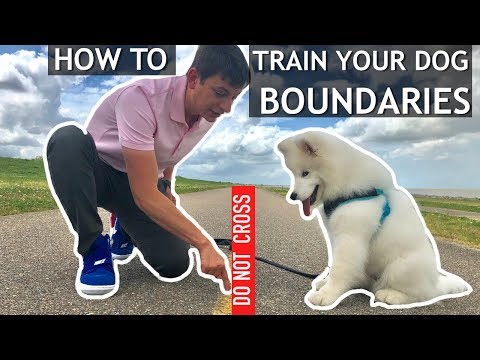
If you’re not ready for a GPS fence or want to start training immediately, these three methods work with just a leash, treats, and patience. They also work as a complement to GPS fence training.
A study conducted in the Netherlands showed that dogs learn and retain skills better with fewer sessions per week rather than daily training. Choose a few days per week, work in 5–15 minute intervals, and give your dog breaks to maintain focus.
Method 1: The Basic Boundary Method
What you need: Retractable leash, collar, treats, a favorite toy, and a helper.
Leash your dog and walk the perimeter of your property. Each time your dog steps outside the boundary, stop and gently tug the leash to guide them back. Reward when they return inside the line.
Once your dog walks the perimeter without straying, introduce distractions. Have your helper run past the boundary. If your dog doesn’t chase — reward. If they do, use the leash to guide them back and give the “leave it” command.
Up the difficulty by throwing a toy outside the boundary. Reward your dog for ignoring it. Once your dog is consistent on-leash, remove the leash and practice in short supervised sessions, rewarding for staying inside the boundary.
Method 2: Boundary Training with Sit Command
What you need: Leash, collar, treats, boundary flags (optional — available at any hardware store).
Walk the perimeter with your dog on-leash, pointing to the boundary line. Optionally place brightly colored flags as visual markers. Do several laps over a few days.
After a week of perimeter walking, stop at various points around the boundary and give the “sit” command. Reward each time your dog obeys.
Next, give the “stay” command and walk outside the boundary yourself. If your dog follows, guide them back inside with the leash and reward. If they stay — return inside and reward.
Once consistent, throw treats outside the boundary and use “leave it.” Reward your dog for ignoring the treats and staying inside the line.
Method 3: Clicker and Flags Training
What you need: Leash, collar, treats, clicker, boundary flags.
Start indoors. Place two flags a few feet apart. Click and reward when your dog touches or approaches the flags. Repeat until your dog consistently connects flags with clicks and rewards.
Gradually spread the flags further apart. Once consistent indoors, move the flags outside to the perimeter of your yard.
Remove the leash and walk the perimeter with your dog, clicking and rewarding at each flag. As your dog learns the boundary, start removing flags one at a time until your dog stays inside the boundary without any visual markers.
GPS Fence vs. Manual Training: Which Is Right for You?
| Factor | GPS Fence | Manual Training Only |
|---|---|---|
| Training time | 2–4 weeks | 4–8+ weeks |
| Works when you’re away | Yes — collar enforces boundary | No — requires supervision |
| Escape alerts | Real-time phone notifications | None |
| Portability | Any property, unlimited boundaries | Retrain at each new location |
| Cost | $524–$919 one-time | Free (just your time) |
| Best for | Any yard size, especially ½ acre+ | Small yards with supervision |
For most dog owners, a GPS fence paired with 2–4 weeks of manual boundary training gives the best of both worlds: your dog learns the boundary through positive reinforcement, and the collar provides a consistent safety net.
Not sure which GPS fence fits your situation? See our SpotOn vs Halo comparison for a side-by-side breakdown, or check if your yard is better suited for a wireless fence.
Why Does My Dog Keep Escaping the Yard?
Before you start training, it helps to understand why your dog wants to leave in the first place:
- Boredom. High-energy breeds need exercise and stimulation. A bored dog will find a way out.
- Not spayed or neutered. Intact dogs have a strong drive to roam.
- Fence gaps. Check for holes, loose boards, or gaps at the base where your dog can dig under.
- Prey drive. Squirrels, rabbits, or neighborhood cats can override even good training.
- Anxiety. Thunderstorms, fireworks, or separation anxiety can cause dogs to bolt.
GPS fences address most of these because the boundary enforces itself regardless of the trigger. But understanding your dog’s motivation helps you choose the right training approach and set realistic expectations.
Frequently Asked Questions
How do I keep my dog from leaving the yard?
The most reliable method is a GPS dog fence combined with boundary training. The fence creates a consistent, enforceable boundary while training teaches your dog to respect it. Without a fence, manual boundary training with a leash, flags, and treats works — but requires your presence to enforce.
How long does boundary training take?
With a GPS fence, most dogs learn the boundary in 2–4 weeks of short daily sessions. Manual training typically takes 4–8 weeks or longer, depending on the dog’s temperament and your consistency.
Can I boundary train my dog without a fence?
Yes. The three methods above (basic boundary, sit command, clicker and flags) all work without any fence technology. However, without a fence, your dog should never be left unattended in an unfenced yard — training reduces risk but doesn’t eliminate it.
What’s the best GPS fence for yard training?
Based on our testing, SpotOn is the most accurate GPS fence for yard boundary training — 8 inches of average drift with zero missed corrections. Halo Collar 5 is a strong runner-up at a lower price point. See our full GPS fence comparison for details.
Is it cruel to use a GPS fence for boundary training?
GPS fences use progressive warnings — tone first, then vibration, then static correction as a last resort. Most dogs learn to turn around at the tone within the first week and never experience a static correction after training. We recommend using vibration-only mode whenever possible. The alternative — a dog that escapes into traffic — is far more dangerous.